25 August 2025

Sea Lebrities: The Sea Lions of Pier 39

We often read about people taking over the natural habitat of other species but today the Ark in Space tells the story of a rare case when the animals came back and reclaimed their territory from us.  It happened in San Francisco - where admittedly stranger things may have happened over the years.

Local Californian Sea Lions have always been present in the city’s bay but had been pushed out to Seal Rocks, a small formation at the north end of the Ocean Beach.  Pier 39’s K Dock was developed and opened in 1978.  Little did we know that the sea lions also had their eyes on this particular piece of seaside real estate.

The Ark in Space has a great feature, packed with pictures, telling the history of these unusual squatters!

First Image Credit Flickr User WallyG

11 April 2022

Franklin: The Lost State of America

What led to the creation of the State of Franklin and why isn’t it around today? Over a period of four years the fledgling state sought recognition even pleading with an ex-president for his seal of approval. Yet its history was to be all too brief. So what happened?

Even more to the point, why hasn’t anyone ever made a movie out of this strange but remarkable story?


Image Credit Note the county by the name of Sevier? Remember that name, it's important later.

Everything invariably boils down to one thing in politics, and that is money. After the revolution it was in short supply and the federal coffers were empty. Revolutions after all, cost money just as much as any war. North Carolina, quite remarkably, decided to cede its western portion to make up its contribution. Getting cold feet, the offer was withdrawn before Congress had even had a chance to accept it. The fear was that Congress might sell the land to a foreign power. Better to be poor than live next to the French, after all.

However, the locals weren’t terribly happy at all (to say the least) at this almost casual secession of their lands and had, in the intervening time, decided that Federal rule would suit them quite nicely. Plus, North Carolina had always been tardy in offering support against attacks by local indigenous tribes or for that matter against the wanted men who used the remote area as a hideaway – unfortunately bringing their law breaking habits with them.

In August 1784 delegates from three of the eight western counties of North Carolina met in the town of Jonesborough. There was a vote (by no means unanimous, a gentleman by the name of Tipton was vocal in his opposition) and on the 23rd of the month they declared the lands independent. The state of Franklin was born. Opposition was immediate - North Carolina published a manifesto condemning the formation of the new state (see above left). In fact it brought about the first political pamphlet war for that part of America.

19 May 2018

Alaskan Summer

If you think that summer never lasts for long, spare a thought for your average Alaskan.  At around four weeks in length, summer in Alaska takes a long time to arrive and then is gone before you barely get used to it. However, with around twenty three hours of daylight, plant life here at the edge of the Arctic bursts in to life. There is a side to Alaska that does not necessarily always have to involve the white stuff.

A landscape of Fireweed in the shadow of Mount McGinnis. Although Alaska is home to lots of ice and snow, summer warms some of it up quite nicely. The state's second city, Anchorage, is protected by the Alaskan Range and the Chugach Mountains.  Add to that the warming currents of the Pacific Ocean with low humidity and the summer temperature can rise in to the 70s.

30 June 2013

The Dogs of War – A Tribute to the MWD, Military Working Dogs

Dogs have been used in warfare for millennia – and are still trained to operate in war zones today. The Ark in Space today has a pictorial feature on the Military Working Dog. From the scouts to the tracker, detectors and sentries, this is a tribute to those dogs who work with the military today - and of course their trainers.

13 April 2012

Holi


If you live in a large, multi-ethnic city virtually anywhere in the world it is a possibility that you have seen groups of people in parks merrily spattering each other with paint. While you might be excused for thinking that it is a new form of corporate team building – and what a great one that would be – you would be wrong. The throwing of multi-colored water and powder is in fact the popular Hindu spring Festival of Colors, also known as Holi. Look at it another way - this is the world's original religiously sanctioned flash mob!

This festival has been conducted in India and Nepal for hundreds of years but as the Hindu diaspora grows other countries as far afield as the UK and the US are getting involved in the fun. Fun, of course, but like Christmas in as much as it has some serious religion at its heart.This remarkable video was created by Variable.

27 October 2011

America in the 1970s – The Documerica Legacy

Documerica was a project which ran from 1971 – 1977.  The Environmental Protection Agency (EPA) asked a group of hired freelance photographers to capture America in terms of both the environmental problems it was facing then and everyday life.  Now, thanks to the US National Archives you can see many more of these pictures – this is simply a selection of the ones which we really, really liked.

Although it is only forty years since the project began many of these pictures seem much older, as if from an earlier time. Yet the various strands of seventies culture come together in a vivid snapshot of what life in all its diversity was like in the USA in the 1970s.

The US National Archives has digitized thousands of these photographs.  You can see hundreds of them on their Flickr page which also gives details about how you can see the rest. Or, if you want more details about any picture here, simply click on it for a broader description.


22 August 2011

Detroit Science Center Mass Lip Dub


OK, stand up who maintains that science (and scientists) are boring! Here is definitive proof that science is far from that – or at least the people involved with it.

For no apparent reason (except perhaps to have fun) the staff and members of the Detroit Science Center join, en masse, in a lip dub of Queen’s Don’t Stop Me Now.

As you watch it you will begin to get an idea of just how much organization must have gone in to this. First there were a couple of weeks pre-production in order to plan the event. Next the production department and singers rehearsed.  The final thing to do was to call all the members in and have an amazing night!

The whole lip dub extravaganza took a walk through and then five takes - it seems that all the kids were in bed on time (the low point for them I bet, and I can just imagine the parents trying to get them to settle after this excitement!). Of course, you can see that the people involved are not professional actors or singers and this makes this mass lip dub all the more fun for me.  Plus we get to see the whole of the Science Center and its facilties and exhibitions which is as good an advert as it could ever have.

With the best will in the world, there never seems to be a huge amount of good news coming out of Detroit.  Yet this not works as a great promo for the Detroit Science Center, it shows the city and its people in a wonderful light too.

28 December 2010

December 2010 Blizzard Timelapse


Kuriositas is based in the UK (as you may or may not know but do now) and recently we have had the coldest December on record.  What that meant was snow - and quite a lot of it.  Yet every time we have a spot of inclement weather in the UK the whole country grinds to a singular and sudden halt.  True, some areas were badly hit but nothing quite as bad as this.

Here is forty seconds of timelapse footage of the blizzard which has brought a large amount of the USA to a standstill.  It covers a period of about twenty hours and was shot by Michael Black in his garden in New Jersey.  The equipment used (if you care to know) was a Canon DLSR on tripod with remote timer taking a photo once every five minutes.

So if you are in the UK (and responsible for traffic, roads, rail or air) take a look at this - this is what real snow looks like.  Goodness only knows what would happen if there was this amount of snow falling in the UK.  The government would probably tell us to seal our houses and burn all the books.  After all, they will have seen the best instructional film around, The Day After Tomorrrow.

Thanks to Neatorama, where we saw this.

25 September 2010

Atchafalaya – the Biggest Swamp in the States

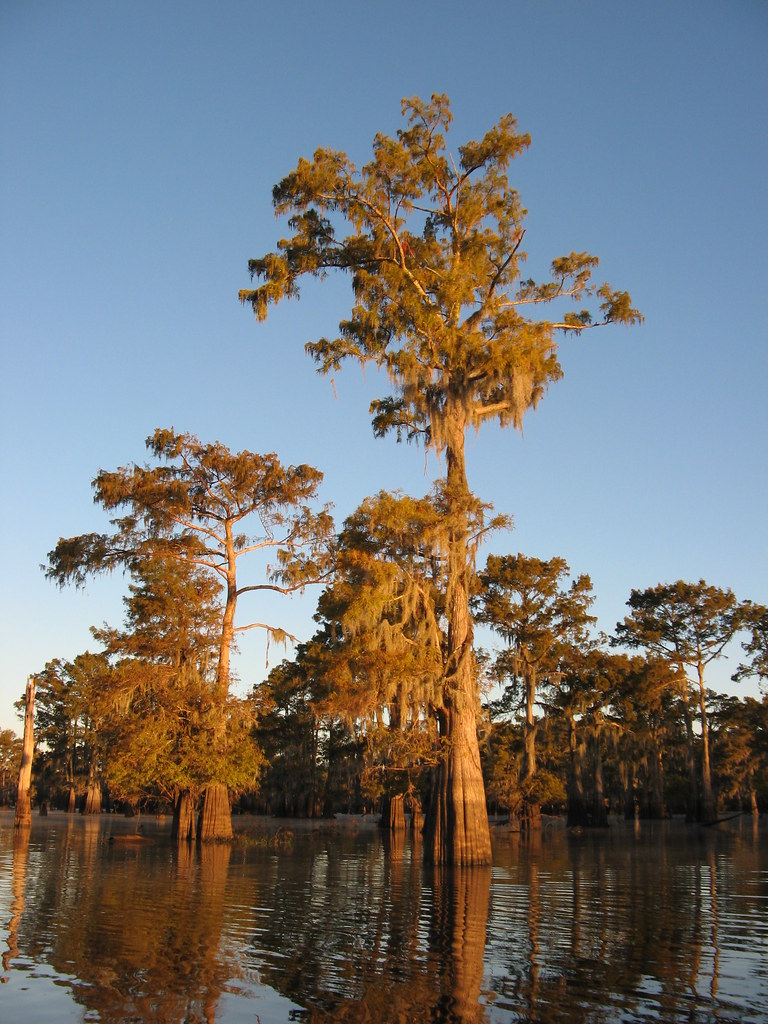
Atchafalaya – the name itself is something of a mystery. When exactly the swamp got its name is unknown, though it means long river in one of the local languages. What is known about this place of splendor and inscrutability is that it is the largest swamp in the United States and is the spiritual home of Cajun culture.

Louisiana is culturally rich, drawing from African, Caribbean, Native-American as well as European culture and the ecology of Atchafalaya is just as diverse and varied. If you want to pronounce it properly, try these syllables - ah-CHA-fa-LIE-ah – and you may be as close as you are ever going to get.

The swamp itself (known also as the basin) adds to the Louisiana mix, combining both a river delta where the Gulf of Mexico and the eponymous river come together and some of the most astonishingly beautiful wetlands on planet earth. While the wetlands are nearly stable the delta system itself is continuing to grow.

A pristine cypress and mixed wood swamp, Atchafalaya looks at times how you might imagine earth looking millions of years ago – the sight of a dinosaur would not be amiss here. Although you might not meet a stegosaurus the chances are you will see beaver, otter, mink deer and many other mammals. Alligators can also be found in the waters of the Atchafalaya.

As it is often heavily flooded the area is very sparsely populated which helps to place it in to the top ten wildernesses of the United States. Altogether the basin stretches out to twenty miles in width but lengthwise it is almost 150 miles. This area is just under 600,000 acres and as such makes it the largest swamp in the US and a place of national significance in terms of ecology and wildlife.

There are few roads that cross the Atchafalaya and those that do follow the top of levees. If you are in a car, however, the longest stretch next to the swamp is on Interstate 10, part of which consists of an eighteen mile long bridge built on elevated pillars, affording views of the basin.

However, the best way to experience the swamp is not from the side, but from within. Yet the damming of the bayous and activity by the US Army Corps of Engineers has led to a decreasing of the rate of siltation. The water moves much less than it once did and has meant that it is less aerated – much of it is now black instead of brown. Many ecologists see the shrinkage of the delta country as one of the biggest ecological threats to the US at present.

There are still people who make a living fishing the waters of the basin. It floods each years and these floods create the right environment for species such as crawfish to reproduce and grow. Yet in recent years the floods have not come at all – and when they have they have carried with them too much extra silt which buries the breeding grounds. The flow of water is controlled by human hand – and is doing damage.

It can also only be hoped that the currents of the river can keep the oil from that spill out in the Gulf. If the water levels of the swamp become too low in the fall then the oil could find a way in to it, bringing with it a devastation that the swamp has never seen before. It can only be hoped that this does not happen.

Magical is a term which is overused when describing places. However, there is no more appropriate a word than that for the Atchafalaya swamp. Whether this, one of the last truly great places of wilderness in the United States will still be able to transfix and fascinate future generations by its dual nature - serenity and strength - is yet to be seen.

Image Credit Flickr User fratch 
Acknowledgements
Kuritas would like to thank Flickr Users StevenLPierce, fratch, David Jonze, dnskct, gail des jardins, and particularly Ebla442 and amaw for giving their permission to use the photographs above.  Please, visit their amazing photostreams!