11 July 2026

The Sky Blue Mushroom


It looks like it could be something offered to Alice just before she makes a journey in to Wonderland but this sky blue mushroom is not a product of the imagination of Lewis Caroll.  It can be found on both islands of New Zealand – and bizarrely enough in a few places in India.

16 July 2025

Volcanoes in the Back Yard

Even when you know that the area in which you live is prone to earthquakes, perhaps the last thing you might expect is a volcano in the back yard. Yet these are not the volcanoes we see in Hollywood movies. Neither are they the mud volcanoes which occur near geysers. These are something quite different. These are sand volcanoes.

A sand volcano usually occurs after an earthquake. It is formed when sand is thrown up to the surface from a central position. As the sand is ejected it builds up in to a cone, taking on the appearance of a volcano as the sand comes to rest on its sides. A crater forms which can range in size from the tiny, just a few milimeters, to one which can extend to several meters.

24 February 2024

The Mysterious Moeraki Boulders


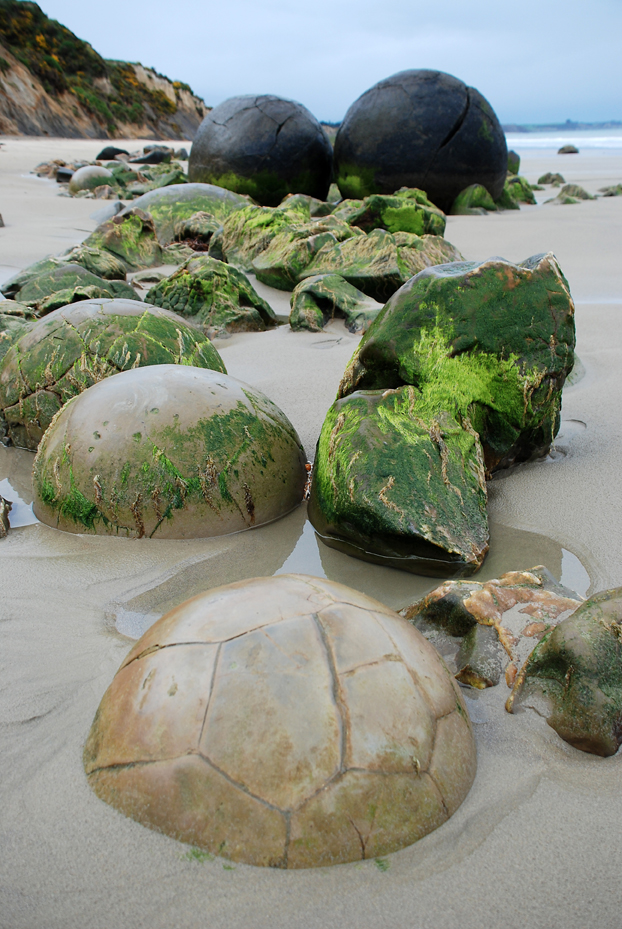
If you go down to Koekohe beach in New Zealand you can be sure of a big surprise. In front of you, scattered like enormous marbles from some long abandoned game between giants, are hundreds of giant spherical rocks. Or are they the egg shells of sea-born dragons? The Moeraki boulders present us with a mystery – what are they and how on earth did they get here?
Image Credit Flickr User Geofftheref
Some are isolated but may occur in clusters. That they are here is the result of three things – erosion, concretion and time. First the waves, inexorable and patient, have pounded the local bedrock for countless millennia. The mudstone on the beach – rock which was originally mud and clay – is slowly but surely eroded. Underneath are the boulders that the mudstone – in its original wet form, helped to form. However, the boulders were not there to begin with – that came later.

29 September 2021

If You Have Never Wanted to Visit New Zealand, You Will After You Watch This


In March 2016, Francis Gagnon flew to New Zealand. For more than a month, he traveled across the country seeking images and adventures. During this journey, he drove 4000 km and hiked over 250 km. His journey took him from the glaciers in Mount Cook National Park to mountain-ringed Lake Te Anau and the volcanic rock in Tongariro National Park.  The result is Moods of New Zealand, an amazing timelapse film of the sights he encountered on his trip.

7 February 2021

The Twisted Trees of Slope Point

This is Slope Point. It is the southernmost tip on New Zealand's South Island. The airstreams loop the vast circumpolar Southern Ocean unobstructed for 2000 miles and then they smash into land. Here. They are so persistent and so violent that the trees are perpetually warped and twisted into these crooked, windswept shapes.

Unsurprisingly, no-one lives at Slope Point.  Yet like virtually everywhere else in New Zealand you will find sheep in abundance.  Even these hardy creatures need some shelter from the elements and so, decades ago, local farmers planted saplings which they hoped would afford their animals some respite from the often savagely inclement weather.

6 January 2018

If You Have Never Wanted to Visit New Zealand, You Will After You Watch This


New Zealand is an incredible place to visit and if you have five months, as Man and Drone did, then you will be able to take in a great deal of this fascinating country.  Here you have a combination of drone footage and timelapse which showcase the simply gobsmacking beauty of the place.  If you are planning a visit to New Zealand you  might want to read the accompanying article to this incredible piece of film.

25 June 2016

Escargore


Claude and his friends chose the wrong lettuce to have for lunch and now they have been plucked from their garden home and in to the kitchen.  Can all five of them make it back to freedom?  Going by the title I think you can guess what happens next in this entertaining horror comedy for snails by a group of students at the Media Design School in New Zealand.

6 August 2014

Ten Thousand Days


If you think that your family is cursed then spare a thought for the Duncan clan. Five generations of the male line have died on their ten thousandth day and now it’s Darby’s turn.  At least he has company, however.  He meets Arabella at the funeral of his cousin (guess when he died) and could it be something called love at first sight?

You will have to watch to find out but this is a short film with a rich (but dark) comic seam and more than a few laugh out loud moments.  This may sound weird but Ten Thousand Days gave me the impression of being the illegitimate child of Monty Python (circa Holy Grail or even Palin’s Ripping Yarns era), a Quentin Tarantino movie (circa Kill Bill) and perhaps a pinch of a young Richard Curtis thrown in, script wise.  Look, read the news, anything can have three parents these days... Or perhaps it’s just me having a slightly odd Sunday afternoon momento mayor.  Either way I do believe you will thoroughly enjoy Ten Thousand Days – but watch out for the magpies.

The movie stars Morgana O'Reilly as Arabella and Benedict Wall as Darby Duncan.  It was written and directed by Michael Duignan.

16 November 2012

Gollum Catches Lunch at Wellington Airport

The muck and pool is nice and cool, so juicy sweet! Our only wish, to catch a fish, so juicy sweet! Well, yes. Exactly.  We all know how Gollum liked his lunch, wriggly and raw, but how would you like to be reminded of the fact while you are having yours?

Very much so. This amazing – and huge – sculpture has just been installed at New Zealand’s Wellington Airport. It has been designed by Weta Workshop which designed props and effects for The Hobbit trilogy of movies coming our way very soon.  It also gave them the opportunity to not so gently remind people that the country was used as the stunning stand-in for Middle-earth in the movies.

8 October 2012

Frying Pan Lake – the Biggest Hot Spring in the World

In 1886, Mount Tarawera, near the town of Rotorua on New Zealand’s North Island erupted.  It was New Zealand’s largest volcanic eruption and it killed over a hundred people. It left behind a massive crater but nature had other plans for the place. Less than 130 years later New Zealand is the proud owner of the largest hot spring in the world.

17 August 2012

Nothing Special


Have you ever felt embarrassed (or even harassed?) by your parents. The answer is almost certainly yes (no matter how briefly) so, in that case, spare a thought for Billy. His mum thinks he is Jesus reincarnate. Literally.

As you can imagine that makes Billy, who reckons he is nothing special, more than desperate to keep it from his work colleagues. He goes to great measures to fade in to the background as much as possible, even limiting himself to a handful of words that he can utter each day. Of course, mum has to come back in to the picture sooner or later..

This very funny short film from New Zealand was created by Helena Brooks. After watching it you won’t be surprised that it was nominated for the Palme d’Or at the Cannes Film Festival and has won a number of awards on the film festival circuit.

31 January 2012

How to Blow Up a Ship

When the HMNZS Wellington had come to the end of its life the decision was made to scuttle the frigate. Yet this was no act of environmental vandalism on a grand scale. The controlled explosion, off the south east coast of Wellington, New Zealand, had a much more munificent objective. The aim was to blow up the ship in order for it to become a new reef on the ocean’s floor. It was quite an explosion, too!


Artificial reefs are being created in order to give a new habitat to coral and other small organisms. This in turn attracts larger animals and before too long you have provided local underwater wildlife with a great new home not to mention a cool new diving destination. The explosion is enough to bring out the excitable young kid in all of us too!

Down she goes!

As the frigate sinks only a cloud is left to show where it once was. Yet it is about to become home to a new set of inhabitants.


Image Credits
First Image Credit - Flickr User Philip C
Explosion images - Flickr User Pieter Pieterse
Last 4 pictures - Flickr User Phillip C

29 November 2011

Hobbiton Reborn!

Just over a year ago Kuriositas reported on the state of the set of Hobbiton in Matamata, New Zealand. The news wasn't good.

After the filming of the Lord of the Rings, the owners of the farm upon which Hobbiton was created asked if some of the hobbit homes could remain to serve as an additional tourist attraction to the area. And they made it so, but soon things were being taken over by the sheep! Yet there is now good news from The Shire - what a difference a year can make!

Thanks to Sir Peter Jackson and his crew returning to Matamata to film the ‘prequel’, the set has been rebuilt – and how!  Sir Peter Jackson’s company and the farm have entered into a joint venture arrangement to allow movie fans to visit the newly reconstructed film set of The Hobbit. Sir Peter was recently pictured with New Zealand Prime Minister John Key (below) on the set which is now open again to the public - but with the set properly retained this time!

If you want to see how the set looked before Sir Peter’s return, please click here. However, below is a selection of pictures from the set which you are now able to visit, should you be (handily enough) in New Zealand any time soon! It seems odd, in a way, being able to visit the set of a movie which is yet to be released…


27 November 2011

Das Tub


Lost in the icy depths of the Atlantic Ocean a World War II German U-Boat crew find themselves on a collision course with objects stranger than they can fathom. The truth leaves them bathed in confusion in this submarine drama of domestic proportions.

It’s also perhaps not quite what you were expecting from something which starts off so straight faced.  However, once the truth is revealed, if you think you have seen it all, just wait till the final few moments of this most amusing short.

This is a live action and computer graphic animated short film with 35 visual effects shots from the Advanced 3D Productions course at Media Design School in New Zealand. With fully computer graphic underwater submarine shots and 3D submarine interiors composited behind green screen film actors, this film was made by a team of 5 digital artists in just 8 weeks.

27 September 2010

The Mysterious Moeraki Boulders

If you go down to Koekohe beach in New Zealand you can be sure of a big surprise. In front of you, scattered like enormous marbles from some long abandoned game between giants, are hundreds of giant spherical rocks. Or are they the egg shells of sea-born dragons? The Moeraki boulders present us with a mystery – what are they and how on earth did they get there?

Some are isolated but may occur in clusters. That they are here is the result of three things – erosion, concretion and time. First the waves, inexorable and patient, have pounded the local bedrock for countless millennia. The mudstone on the beach – rock which was originally mud and clay – is slowly but surely eroded. Underneath are the boulders that the mudstone – in its original wet form, helped to form. However, the boulders were not there to begin with – that came later.

Many of the Moeraki boulders give the impression of being completely spherical – and they almost are. They are septarian concretions – a sedimentary rock that has had the space between its individual grains filled up by minerals which acted like cement. Concretions form inside the layers of mud and clay and are not, as some think, boulders buried over time.

They do, however, tend to form early on in the history of the deposited sediment – it is thought they occur before the rest hardens in to rock. A consequence of concretion is that the resulting boulders are more resistant to the weathering effects of the element. So, when the rest of the sedimentary layers is eroded, the boulder (eventually) appears.

What is significant about these concretions is their size. They are big. While not unique on the planet, some of them are up to a meter in diameter but the majority range from 1.5 to 2.2 meters – that is almost seven feet in diameter. Most of them are almost perfect spheres.

The material responsible for their concretion is a carbonate mineral called calcite. In the center the concretion is sometimes quite weak (perhaps the opposite we might expect) but the exterior is usually the hardest part being made up of sometimes 20% calcite. Not only has the calcite concreted the boulder’s clay and silt – it has replaced a lot of it too.

There are large cracks on the boulders and these are known as septaria. The center of each boulder is hollow and the septaria radiate from there. It is not really known what causes these septaria but they can be filled up by several layers of calcite themselves and sometimes an extremely thin layer of quartz.

The Moeraki boulders date from the Paleocene epoch which translates as the early recent. In geological terms that may well be true, but that means that the boulders are at least fifty six million years old. Our own mammalian ancestors during that epoch were mostly small and rodent like until late on.

As you can imagine, there are many Māori legends concerning these hollow boulders. One says that they are eel baskets that came ashore when a large canoe was sunk. The reality is perhaps stranger than the legend. Yet whenever they get visitors, there always has to be one!