19 June 2025

Ischigualasto – The Valley of the Moon

The name is old – from the native Quechua tribe and it means the place where you put the moon. Ischigualasto is an extraordinary almost off world experience. Geologists have been visiting the valley in Argentina for more than one hundred years. It doesn’t take long to see what attracts them.

26 June 2024

Iguazu Falls – Big Water of the Borders

In the local Tupi language, the word means big water.  One look at the staggering Iguazu Falls, located on the border of the Brazilian State of Paraná and the Argentine Province of Misiones and you realise that this is no exaggeration.

9 April 2023

Cerro de los Siete Colores - The Hill of Seven Colors

The colors could have come from the palette of a painter. Yet the Cerro de los Siete Colores (The Hill of Seven Colors) is quite real.

Millions of years of geological activity followed by erosion have created something magnificent on this Argentinian hillside.

Marine sediments combined with lake and river flows, elevated with the movement of the tectonic plates, combine to produce a dazzling array of color for the eyes to take in.

30 June 2016

Villa Epecuén: Argentina’s Pompeii Revealed

Villa Epecuén Argentina Abandoned Submerged Town Flooded Like Pompeii
Once, people would flock to the small town of Villa Epecuén in Argentina’s Buenos Aires Province to take advantage of the saline, healing waters of its lake. Decades of tourism was wiped away in November 1985.  The rains were unusually heavy and the lake burst its banks.  The entire town of more than 100 blocks disappeared under ten meters of water.

Villa Epecuén Argentina Abandoned Submerged Town Flooded Like Pompeii

2 April 2012

Luminaris


It is not very often that something so simple and yet so delightful crosses our path.  Yet I hope you agree that Luminaris is just that - I haven't sat back and said wow for quite a while, but this short film gave me that opportunity!

Have you ever wanted to escape the rat race? Certainly the protagonist of this silent movie feels that way, if only he could his destiny. Yet in a world controlled and timed by light that isn’t so easy. However, where there is a will, there is a way! There is no day that this short film will brighten up your day (and yes, the pun was intended!).

Luminaris is directed by Pablo Zaramella, an independent director and animator based in Argentina. He has won no end of prizes for his films and commercial and the delightful Luminaris is no exception. The movie won the Audience Award and Fipresci Award at Annecy 2011.

15 May 2011

The Marble Cathedral of General Carrera Lake

Shared by Argentina and Chile the deepest lake in South America is famous for its trout and salmon fishing. The waters of General Carrera Lake are beautiful, a glittering combination of emerald, turquoise, aquamarine and azure. The sky may be blue but the waters seem bluer still. 

However along its banks, directly below the Andes, sheer marble cliffs present themselves to further astound the visitor.  Over the millennia they have been weathered and folded to create a stunning cathedral of marble.

From a distance the lake looks magnificent, although when you get closer its dazzling beauty becomes ever more apparent. The passageways and caverns formed over vast stretches of time are sometimes large enough for small boats to glide through. Albeit precariously.  It does not take long to become enchanted by Las Cavernas de Marmol as this exquisite labyrinth is known locally. Perhaps even the most cynical jaw might drop at this majestic sight.

As well as being the deepest lake in South America, General Carrera Lake is the biggest lake in Chile with a surface area of almost a thousand square kilometers.  It is 200 km long, at an altitude of 350 meters and has a maximum depth of 590 meters. It is known as Lake Buenos Aires by the Argentineans.

The marble protrusions stretch along a beachside and are around 300 meters in length. The waters of the lake have slowly impacted upon the marble and, in their infinite patience, have created something of enormous, almost bewildering beauty, like gigantic walls and caverns of marble medallions. The rock manifests different tones which are dependent upon the natural impurities within the marble. Although the white banks, of immense purity are predominant blue and pink marble banks can also be seen due to the presence of other minerals within the rock.

Strictly speaking, although the Marble Cathedral is spoken of as one formation, in truth it is three. The largest is El Catedral – the Cathedral. There are two smaller formations which are known as La Capilla – the Chapel which rise from the lake, and La Cueva - the Cave.

It has been estimated that these vast sections of marble weigh 5000 million tonnes and consist of 94% calcium carbonate. The area is not in the one of the most hospitable areas of the world but it is lucky.  Although the region is cold and humid the lake enjoys a sunny microclimate. So although you may be cold getting there, once you are there you should be warm!

Although the lake has been known by Europeans for little over a hundred years, they were not the first to discover the beauties of the lake. The indigenous people of the region, the Tehuelches, a once nomadic tribe also known as the Patagons have inhabited the region for thousands of years.  Their name means the fierce people. They must have been to make their way through the isolated strips of plains through which the lake can be accessed on the Argentinean side.

These stunning pictures represent quite an achievement on behalf of the photographers.  Not only are the caves difficult to reach but the lake itself, being so large, can develop swells and waves which make photography quite a challenge. Often, as only small boats can navigate the caves, the journey becomes impossible after a certain point.  Although this would, perhaps, be one of the most beautiful places on earth in which to expire, most photographers are somewhat reluctant to embrace this destiny.

However, it is easy to imagine how the traveler may be inclined to stay in this amazing place much longer than they had originally anticipated. However, there is a problem in this particular paradise.  The Hidroaysen company intends to build five mega hydroelectric facilities in the basins of Baker and Pascua rivers in Chilean Patagonia, destroying the banks of its reservoirs, the original ecosystem, rich fauna and local culture.  To find out more, please visit the Save Patagonia or Patagonia Without Dams websites.

Kuriositas would like to thank Flickr Users Jorge Leon Cabello, Orlando Contreras López, and Ricardo Gallardo for their kind permission in allowing us to share their marvellous photographs with you.  Please visit their Flickr Photostreams.

6 March 2011

Running from God’s Creatures

Just because you are a nun does not mean that you have to take every single situation with calmness and equanimity.  So when these two nuns in Argentina saw this not so little guy coming towards them they decided that discretion was by far the better form of valor.

It is in fact a Crab-eating Raccoon (Procyon cancrivorus) is a species of raccoon native to marshy and jungle areas of Central and South America.  It looks like it is making the occasional inroad in to urban areas too.  Oh - and it doesn;t just eat crabs, it's an omnivore (meaning it could also be a nunnivore!). Run, sisters, run!

22 November 2010

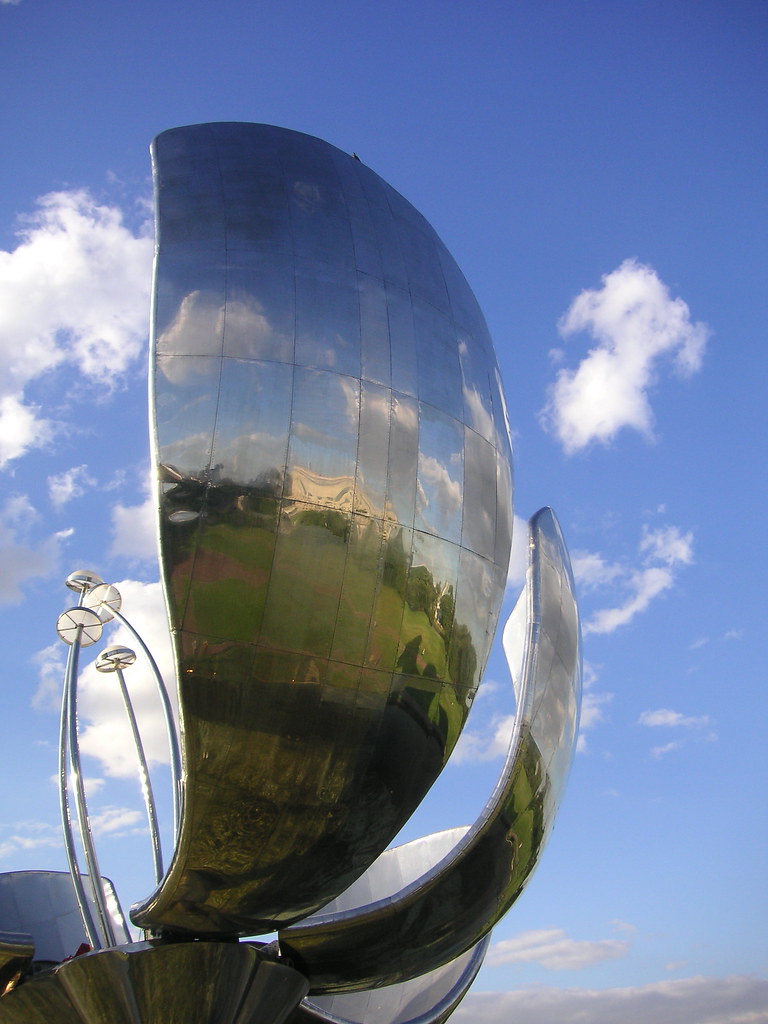
Floris Genérica- The Big Metal Flower of Buenos Aires

If you are a citizen of Buenos Aires you have probably been asked directions to the big metal flower, which to a citizen of that city is somewhat akin to being asked the way to the big white house in the States or the big clock that chimes in London.

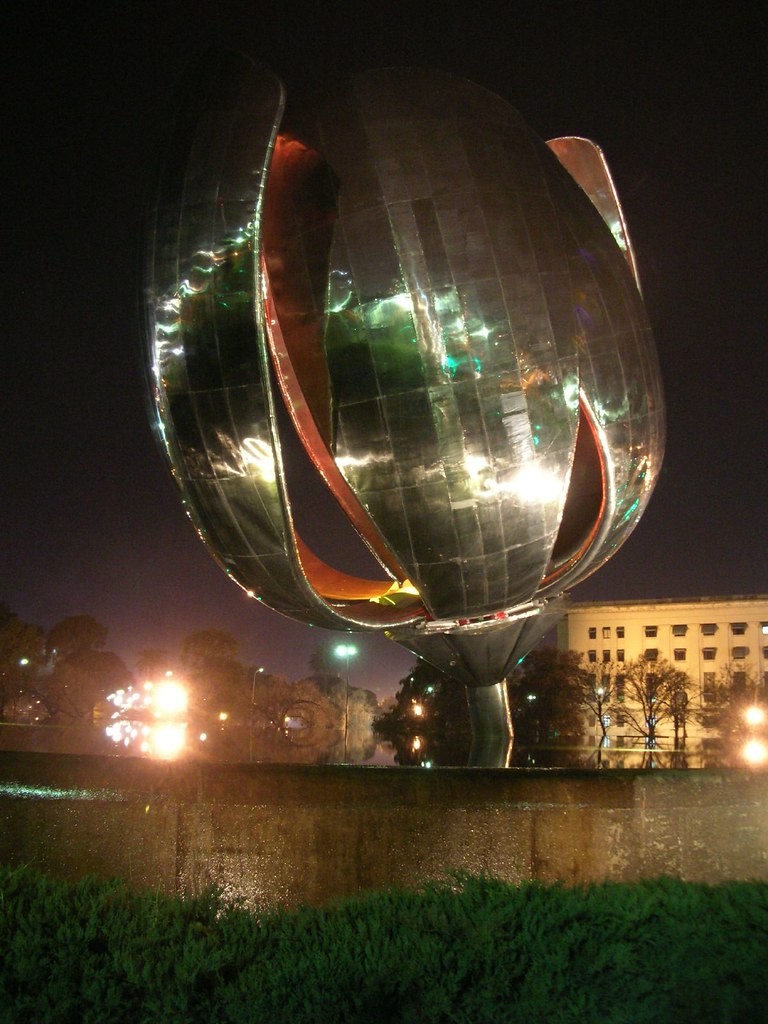
Its real name is Floris Genérica and it is something quite remarkable.  Standing in the middle of the United Nations Plaza (Plaza Naciones Unidas) you have to admit that the description is quite apt.  In the middle of a reflecting pool there it is – the big metal flower.

It was a gift to the city in 2002 from architect Eduardo Catalano.  The architect, who died earlier this year, was born in Buenos Aires and wanted a lasting display and thanks for his home city which reflected both its beauty and its modernity.  Opinions, as with any other piece of art, are divided but it is a potent symbol of both the natural world and the technological one.

The architect himself maintained that it was a synthesis of all the flowers and is both a hope that is reborn every day to open. An expensive hope, perhaps.  At US$6m (a gift from its creator) one might ask was a symbol worth that amount of money?  Most would probably agree it was: the pleasure it gives cannot be measured financially.

From afar it belies its dimensions which are colossal.  The flower has six petals and each of these is 13 meters in length and 7 meters at its widest.  The flower is made from stainless steel and is reinforced by an aluminum skeleton and concrete. 

It is only when you get closer your realise its full immensity. It towers about the pedestrians in the plaza at 23 meters in height and weights and enormous eighteen tons. It is no simple structure by any means – visitors who do not know its secret are in for a surprise twice a day.

This on its own would be remarkable yet there is a mechanism underlying the mostly static majesty of the flower.  Designed by the artist it was constructed by Lockheed Martin Aircraft Argentina.  That may give you a clue what happens.

It is simply enormous.

In the evening the petals close – taking around twenty minutes to do so and mimicking the process with which a real flower greets the sunset.   At night it is resplendent, bathed in red floodlights and array of smaller green lights dotted along the pathways.

If you have never visited Buenos Aires you may not be familiar with the fact that it is a city of dogs as well as people.  The Floris Genérica is popular with joggers for two reasons.  The plaza is a great shape in which you can measure your pace and the distance you jog.  It is also forbidden to dogs, which means your eyes can be elsewhere other than on the ground seeking to locate and then avoid the little presents the canine throng would otherwise leave behind.

On four days the petals stay open all night:  September 21, May 25, December 24 and December 31. The first is Argentina’s National Patriotic Day, the second celebrates the day on which Mario Bunge, Argentine philosopher and physicist was born in 1919.  The last two we think you can guess for yourself.