4 October 2013

Dead Famous


I have always felt somewhat ambivalent about taxidermy and I doubt this short by RGM will change that position.  However, with stunning cinematography and a marvelous narrative Dead Famous does the unexpected (for me at least).  It wrapped me up in its world completely.

Dead Famous was commissioned by London Taxidermy for the launch of Thames & Hudson's new book 'Taxidermy'.

22 December 2010

Don Flavin Created Light Fittings, Not Art

Before you get on to your high horse about Flavin’s art, hold on a second.  The title of this post is deliberately provocative and does not reflect the editorial stance of Kuriositas in any way, shape or form.  However, it does mirror the opinion of the European Commission.

The gravy boys and girls in Brussels have taken a dim light to his art, or so it seems.  When art is purchased and imported in to European countries it has to be taxed.  If it is art then it is taxed at 5%.  However – if it is a light fixture, then it is taxed at the much higher rate of 20%.

In a move which has had admirers of Flavin’s work shrugging their shoulder’s in disbelief, let alone the philistinism of their self-elected bureaucrats,  Flavin’s art – sorry, wall fittings – are now a great deal more expensive.  For those of you new to his art, he was an American minimalist artist who became famous for creating sculptural objects and installations from commercially available fluorescent light fixtures - all the photographs here are by the artist.

Whether or not it is art has been raging for decades - yet to this point it has been one associated with canapés and aestheticism rather than the heavy hand of the law.  Those who dislike Flavin's work may see this move as a justification of their argument.

This is not just an academic argument, however.  If the Tate Modern in the UK now chooses to import some of Flavin’s work they will pay a deal more.  If they pay £100K for a piece it will mean a difference of £15K in taxes – which is a considerable sum of money.  Add up all the art imported over the course of a financial year and you will get a huge figure.

Of course Flavin died nearly fifteen years ago so he isn't exactly around to worry about this.  Yet their are many who will.  Bill Viola, for example, has recently been commissioned by St Paul's Cathedral in London to create two pieces. The nature of his art dictates that the 20% tax will be levied against his work when it enters the UK, causing huge expense to the cathedral authorities.

To get to the heart of the issue, the argument of the commission goes that it is not the installation itself that constitutes the art but the effect of the light once the piece has been ‘plugged in’.  By its own logic it opens questions about the future of importing modern art in to the UK.  Anything that consists of objects which need electricity might have to pay the higher tax as a result of this bizarre new piece of legislation.

If anyone from the European Commission is reading this, then thank you.  At least it gave us an opportunity to feature some of Flavin's incredible work.  As a footnote, Mr Commissioner, this is what light fittings look like in real life.

10 September 2010

Better Sweaters Make Beautiful Beasts

It isn’t a prequisite of art that it must make one smile, but certainly artist Elaine Bradford must have one on her face when she comes up with her ideas. One could almost go a step further and argue that there may have been just a little bit of playfulness involved too.  Art and playfulness can make good bedfellows (for a number of reasons) and that is certainly the case here.

Bradford’s artistic world is imaginary – and is inhabited with its own wildlife.  Yet in this world perhaps the weather is known for its sudden inclemency.  Her animals are the customers of a bespoke clothes maker who painstakingly crochets sweaters and other garments for them.

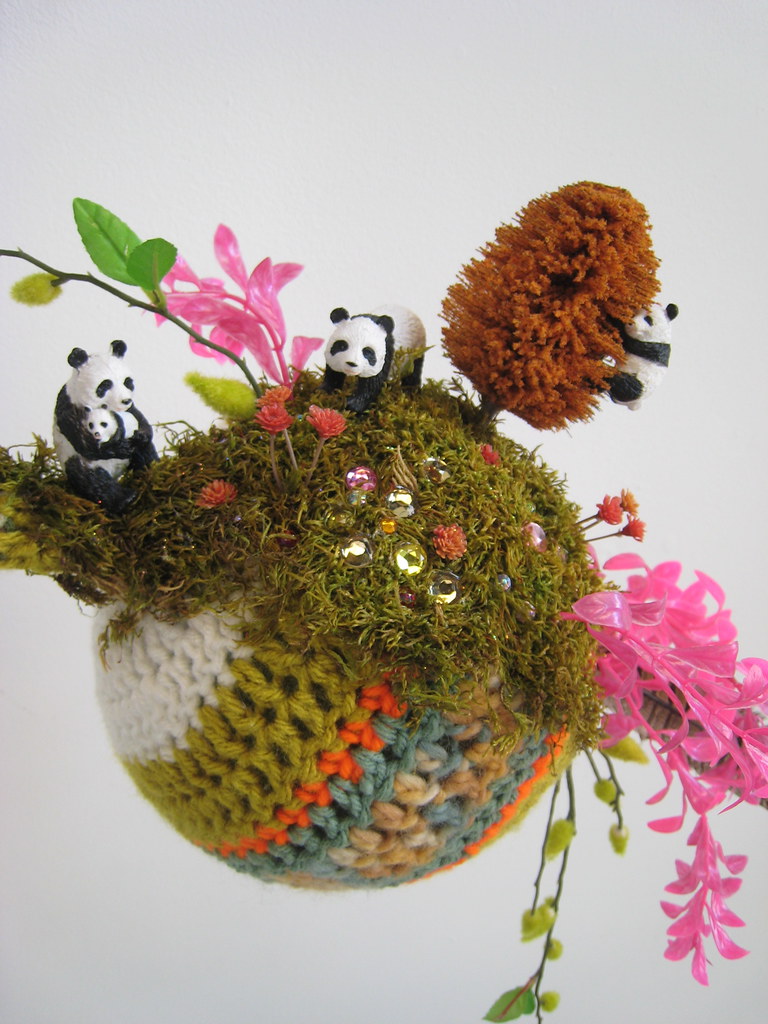
And as with any imaginary worlds there are more worlds within.  The horn of this antelope is extended - and he proudly wears his imagination as well as his crocheted apparel on the outside.  A closer look reveals that his benevolent gaze is directed towards the protected home of a family of pandas.

Bradford is mostly known for this work and the absurdity of the idea led her to create a Museum of Unnatural History where the animals could be displayed.

There is some irony, not to mention satire here.  Anyone who has visited a museum or a stately home replete with its collection of long dead animals, taxidermied and mounted can probably recall the stale taste of dust and the sombre and silent reverence that accompanies such displays.  Perhaps these animals should never have had their lives cut short to adorn the buildings of man.

Yet their lives were destroyed so why not return to these shells a certain joie de vivre?  It isn’t so much reanimation as rehabilitation.

Yet despite this new lease of life (or perhaps because of it?) the animals have managed to escape from their installation at least once and found themselves at one with nature again.  Even though their own form might not be accurately described as natural.

All of this must have taken a great deal of time – not to mention yarn.   Based in Houston, Texas perhaps Bradford’s largest piece is her elephant in a sweater (below) which has echoes for me of Babar (although that is probably my imagination).  She is a MFA (California Institute of the Arts) and her work has been exhibited in many venues around the US.

Image Credit Flickr User esbradford
Kuriositas would like to thank the artist, Elaine Bradford, for her kind permission to reproduce the above images.  Please visit her Flickr photostream and her website where you will find many more examples of her work.