29 January 2017

The Dead Cities of Syria: Ancient Abandoned Cities Now Repopulated by Refugees

The Syrian civil war continues its tragic evolution with the death toll surpassing 400,000 by the end of 2016. It is the latest of many upheavals the country has been through since its formation as a state.  As the conflict continues, much of what remains of Syria’s long and unique history has also, inevitably, come under threat.  Perhaps the best known, the crusader castle of Krak des Chevaliers has been shelled while the giant waterwheels of Hama are in daily peril. While the preservation of human life is forefront in the minds of any person concerned about the ongoing bloodshed, these ancient sites represent history in situ which is of immense importance not only to Syrians but to the world.

Jabal Al Zawiya, Syria
In the northwest of the country are lesser known reminders of past turmoil and upheaval. Over 700 abandoned settlements bear the collective name The Dead Cities of Syria.  The name might perhaps be considered ironic, bearing in mind what is happening in the country’s modern cities at the moment.  Yet these dead cities have become home to thousands of refugees, who have fled from the civil war and now live in the caves beneath the ruins.  Some have even dug up the ancient stone graves and are using them as makeshift homes.  These pictures show the Dead Cities before the war as well as a number of their new residents. There is little or no access to places like this while war rages so the true nature of the devastation will not be known for some time.

23 December 2014

What if Everyone in Manhattan Disappeared?


It is something that we see in science fiction movies and Manhattan seems to be a popular choice in presenting this sort of dystopic nightmare.  One of the fascinating things about such an exodus is seeing the sight of an empty city.  Everything looks normal except for one thing – the complete disappearance of the entire population.

Yet this kind of thing is happening in our world right now – in Syria.  The Assad regime and the rise of ISIS have forced ten million people out of their villages, towns and cities – that is, staggeringly, half the population.  Out of this number more than 3 million are under the age of 16.

This video was created for the UN Refugee Agency (UNHCR) by Purpose and the Hamdi Foundation to raise awareness of this appalling situation by giving us the image of Manhattan emptied of people – perhaps something we know might better help us understand the enormity of the issue.  It is - put simply - the largest refugee crisis since the Second World War.

Where did these missing millions go?  Syria’s neighboring countries have taken in the biggest numbers yet these are not wealthy countries and the strain is becoming intolerable.  Lebanon has, for example, seen its population grown by 36%.  At the last count the UK had taken in just 54 people.

The international community is failing to respond to their needs meaning millions do not have enough to eat, fuel to keep warm or a safe place to lay their heads. Visit http://www.unhcr.org for more information and to pledge your support.

We have the United Nations for many reasons but to help our fellow human beings who find themselves, through no fault of their own, in dire circumstances, is pivotal to it existence.

This issue needs to be addressed but we cannot simply stand by and expect our governments act – as sometimes they need to be prompted.  As a private citizen you can help by persuading your government to unlock crucial funding for UNHCR or indeed make a donation to the Syria Emergency Winter Crisis Alert appeal..

4 September 2014

Miracle Baby: Two Week Old Syrian Child Rescued from a Collapsed Building


They are called the White Helmets and they help – it is really as simple as that. Regardless of religion, regardless of politics, when bombs hit, the White Helmets, aka the Syrian Civil Defence rushes in to offer any assistance they can.

In the video above you can watch Khaled Farah, a particularly brave young man, help in the rescue of a two week old baby trapped beneath a building which had collapsed after a barrel bomb attack.  As much as the survival of the baby was a miracle, it was an astonishing feat by the under-resourced rescuers that the continuation of life became a possibility.

However, Farah and his colleagues are in desperate need of equipment in a country where public services have fallen apart.  Donor governments have millions in existing funds and some of it is not being spent.  It seems that the right projects have not been found!  If any group needs assistance right now with protective gear, medical bags and digging tools, it is the White Helmets of Syria.

You can help out without spending a penny of your own money. The Syria Campaign has launched a petition.  Its aim is to get the attention of donor governments, to show them that the White Helmets need our help here and now.  Please follow this link to sign the petition and support the White Helmets of Syria (there is also an opportunity to learn more on the site if you would like).  It took me less than a minute to do it - but I think it might be the best spent minute of my day.

4 February 2012

The Dead Cities of Syria

Syria continues to be in the news as its government persists in its use of violence to crack down on protests inspired by the Arab Spring. It is the latest of many upheavals the country has been through since its formation as a state. In the northwest of the country are reminders of past turmoil and upheaval. Over 700 abandoned settlements bear the collective name The Dead Cities of Syria.

These abandoned municipalities scatter the landscape and contain the remains of a confident, vibrant and sophisticated culture – one which effectively disappeared over fifteen hundred years ago. Left behind, incredible and ancient structures are testament to the ingenuity and piety of the people who once lived here.

The Church of Saint Simeon Stylites is perhaps the most famous of the buildings in the area.  It is the oldest Byzantine church in the world and dates back to around 475 CE.  It commemorates Saint Simeon who sat atop a high pillar to preach to those who came from far and near to hear him.  This vast martyrium has almost as much floor space as the Haga Sophia in Istanbul (which was, of course, then called Constantinople).

Saint Simeon's pillar is still evident, transported to the church after his death. Yet over the many centuries, pilgrims have chipped away at it for souvenirs until the pillar now is little more than a boulder.

Between the cities of Aleppo and Hama there is a limestone massif and it is here these ancient settlements were built by their once prosperous peoples. The area is about thirty kilometers in width yet is several times longer – extending to almost 140 kilometers in length. It isn’t hard, considering this thin, long concentration of settlements to divine the reason for their presence – trade!

The names of the cities are numerous: Jaradeh, Telanissos, al-Bara, Surkania, Dar Qita, Ruweiha, Surkania.  All are silent witness to a civilization now vanished in to the footnotes of history. Their importance is somewhat blithely underestimated by modern locals who still pick around them, occasionally plant small olive groves among the ruins - and even climb them (go back to the fourth photograph!).

Trade brought in gold and silver, which was used to fund the building of this exquisite Christian Byzantine architecture.  The ethnic makeup of the citizens of these cities would have been diverse, as is so often the case on a trade route. Yet the practiced religion of the cities’ populations seems to have been overwhelmingly Christian. A great many of the surviving buildings are churches.

The nature of the settlements has been a matter of debate for many years. Some argue that these forgotten cities were built by a prosperous and thriving peasant class which slowly strung out its line of influence. It is true that there are very few specifically urban features along the length of the settlements although sturdy domestic architecture has weathered the centuries well.

Others argue that these were, indeed, cities rather than a string of peasant collectives. The main produce of the area was olive oil and the international demand for this valuable product would have ensured an infrastructure comparable to other thriving towns and cities towards the end of the era of antiquity.

Serjilla and Bara, the best preserved of the cities, would seem to support this opinion. There is a bath house in the former, always a sign the prosperity of a city and was built around 470 CE when Christianity was well established.  There is also a meeting place for men, a kind of Byzantine gentleman’s club where important decisions would be made. Its main source of income was grapes and olives, grown in the fertile soil of the natural basin in which it was built.

Bara, on the other hand, seems to have been a military base. Perhaps for this reason it survived longer than the other cities. It was conquered by crusaders in 1098 and taken back by Muslim forces thirty years later.  It was a severe earthquake later in the twelfth century which forced its eventual abandonment. Bara’s retention of population is unusual in the area.

One thing is for sure: the inhabitants of most of these lost cities packed up and left slowly but surely in the sixth and seventh centuries.  The area had been conquered by the Arabs and this meant that trade routes shifted.  Warfare did not do for these incredible settlements but economics. The population declined and dwindled to the point that the cities were eventually deserted.

It is almost comforting to reflect that despite its post apocalyptic appearance, the denizens of these places, the original names of which are long forgotten, were not put to the sword. Rather they headed towards more prosperous cities along newer trade routes, there to settle hopefully in peace. They left behind their churches, homes, meeting places - and their dead.

As the Arab Spring began in early 2011 the dead cities of Syria became a UNESCO World Heritage Site. Tourism to Syria is at the moment effectively suspended but when civil stability returns the local people around the dead cities will resume giving those willing to go off the beaten track a warm welcome.


Image Credit
First picture - Flickr User James_Gordon_Los_angeles


23 October 2010

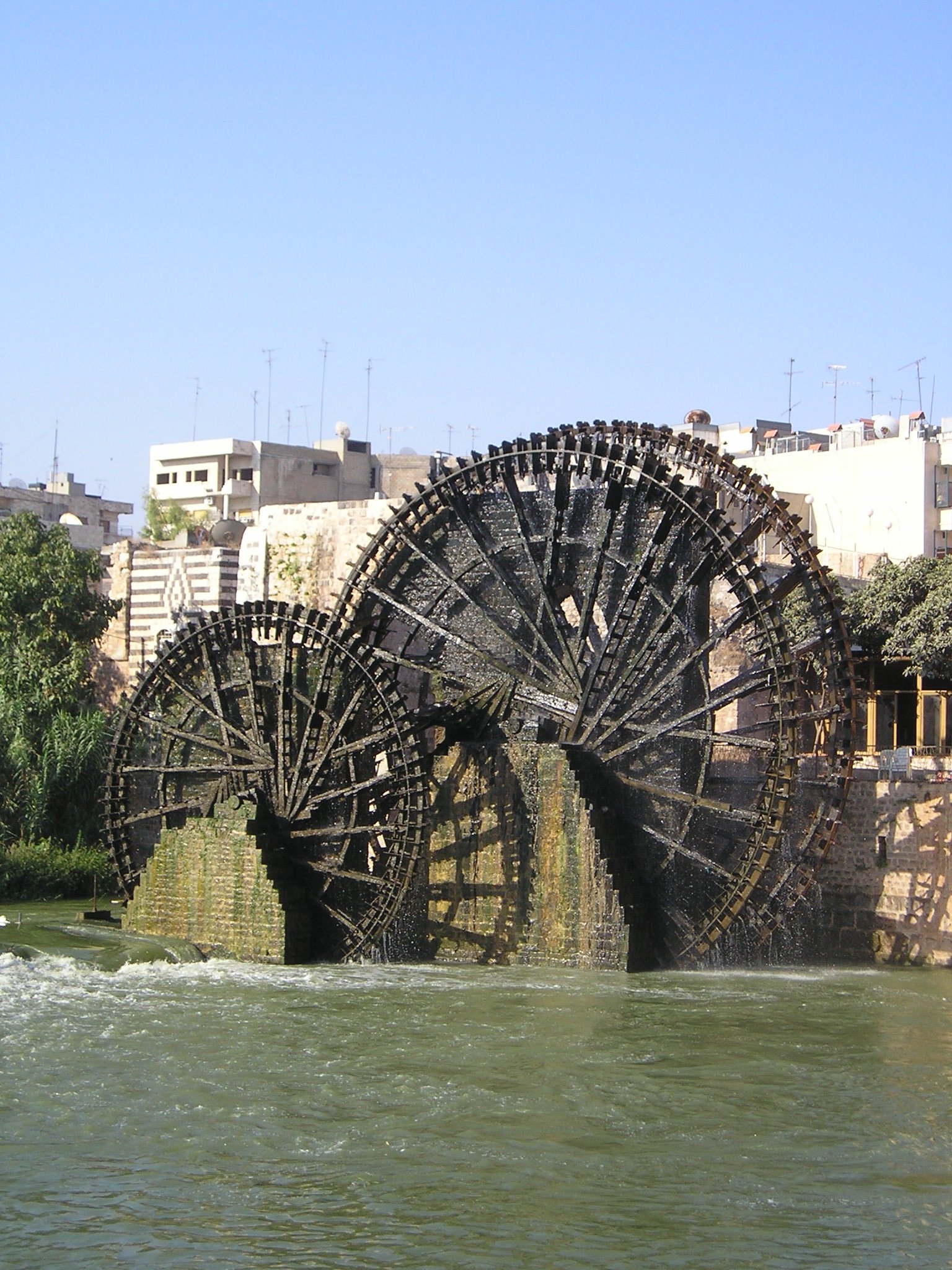
The Giant Norias of Hama – Magnificent Waterwheels of the Past

Their name translates from the Arabic as wheel of pots and for centuries the norias of Hama lifted water in to small aqueducts to irrigate the fields surrounding the Syrian city.  Today there are still seventeen of these magnificently engineered wheels left but are mostly for display purposes only, as it were.

Although there is evidence that there were Norias around the city during the Byzantine era which ended in 1453, the Norias of Hama date from the a little later.  It is thought that they were started in the Ayyubid dynasty in around the twelfth century and enlarged in the Mamluk era of the fourteenth. 

It was at this point that the Mamluk reconditioned, increased and enlarged the amount of Noria in the city as their influence grew.  At one point in what we call the medieval era there were over thirty waterwheels in the city which took water from the Orontes river.   The city must have seemed like a metropolitan oasis.

Each of the wheels can be anything up to 20 meters in diameter (close to 70 feet( and the river water is channelled in to a sluice on the wheel.  This flow then forces the wheel to turn and wood boxes raise the water upwards.  At the top of the wheel there is an artificial channel in to which the water is discharged.

Using gravity, the water then flows through aqueduct channels to either households or farms in the vicinity.  Just as math was used in the construction of the waterwheels so it was in working out the times at which people had access to the water.  As a precious commodity it was important that it was shared fairly.

There are no other mechanical processes involved in the purpose of a noria – the power it produces is not used to run a mill for example.  The undershot of the wheel has a rim consisting of a number of containers and they lift the water upwards.  Conceptually it is similar to the hydraulic ram.

The largest noria in Hama is the al-Mohamadiyya, the purpose of which was to supply the city’s Great Mosque with water and its aqueduct is still there – or at least part of it - it does end rather abruptly about one hundred meters away from the noria.  Work started on this greatest of the wheels in the fourteenth century, at about the same time as Dante wrote The Inferno.  It is the largest noria in the world.

The origins of the noria are obscure but it is thought that they were invented in India or the Hellenistic Near East in the centuries preceding the birth of Christ.  It is also believed that they were pivotal in the Muslim Agricultural Revolution which started in the eight century and lasted several hundred years.  Islamic Spain also used the noria and there are still a number there too.

The noria of Hama were almost industrial in their capacity.  The largest has 120 water collectors and was capable of delivering almost one hundred liters of water each minute to the aqueduct.  Although none of the larger noria are now in use they are being maintained by the Syrian government so that future generations can witness the ingenuity of centuries gone by for themselves.