9 December 2018

Bronze Mischief - The Sculptures of David Goode

Take a walk in an English country garden at this time of year and you never know quite what you are going to come across. One moment you are busy doing nothing and the next moment you are caught up in a world of playful if naughty creatures from a hitherto unseen world. And for sure these are naughty – they are goblins and elves. There is none of the wafty grace of the Cottingley fairies here. These guys are up to mischief.

In fact, this is the work of David Goode (pictured left), a British sculptor based in the English county of Oxfordshire.  After having spent many years studying the human form – he was the youngest ever waxwork modeller for Madame Tussauds – he turned his attention to another world entirely.

Having spent so much time with wax, when he turned his hand to bronze work he determined that he would also make his work as believable as possible in this medium.

31 August 2011

The Wanderings of the WEEE Man

People around the United Kingdom have been in for a big surprise. A seven meter three tonne metal man has been wandering in their midst. Who (or what) is he and why is he here? Is the Earth about to stand still? Hardly, but like Klaatu he brings a message to which we should really listen!

Asking people to think about waste is sometimes difficult – you might even say it can be a waste of time. People do not like to be preached at. So how on earth do you make a European Union Directive interesting enough to grab people’s attention? Through art? Well, it’s worth a shot! A mysterious seven meter creature was born.

So here is the result – WEEE man! On average a citizen of the United Kingdom will produce 3.3 tonnes of waste in their lifetime. At the same time that sounds like an enormous amount but, considering our lifestyles in the West it does seem rather small at the same time. This is only, in reality, a fraction of the waste that one person creates. In fact, it only represents the electrical waste that will be produced by an individual in their lifetime. The WEEE man weighs in at this exact weight – and as such offers a direct insight in to the enormity of the problem.

What is he made of? Firstly, large household appliances, such as washing machines and television sets make up a large part of his structure. Then there are smaller objects, such as toaster, irons, and other electrical tools. There is lighting equipment and automatic dispensers, IT and telecoms equipment and toys and leisure items, all making up this latter-day Frankenstein’s monster of Brobdingnagian proportions. This guy is big! Waste is no longer out of sight, out of mind. The hope is that his birth will make people think about their behavior when it comes to disposing of the electrical equipment they no longer want.

People still do not consider recycling sufficiently. To draw attention to this the British Royal Society of Arts started to think – and think big. Hugh Knowles Mark Fremantle, both Fellows of the RSA developed the idea in tandem with Giraffe Innovation. The result was WEEE man – seven meters tall and, yes, over three tones in weight. He is a scary looking guy – hardly the ‘wee’ man you might imagine if you were told you were to be introduced to him at the bar after work! Wee, of course, is Scottish slang for someone of diminutive stature – and this wonderful play on words is integral to the impact of this work of art.

At the risk of sounding like a cosmetic ad, here’s the science (or at least the boring bit – the reason why WEEE man was created in the first instance. WEEE actually stands for the Waste Electrical and Electronic Equipment Directive (WEEE) which became European Law way back in 2003. Its aim was to set targets for the collection, recovery and (mais bien sur!) the recycling of any and all types of electrical equipment.

The law recognizes that it is not the sole responsibility of the buyer to dispose of their electrical equipment once it has become redundant. Rather it is the equal responsibility of the manufacturer to ensure that their customers can return their WEEE with ease – and for nothing. Additionally, the organizations mist use the collected materials in a way that is ecologically friendly – which means no more selling off the used goods to poorer nations to bury a few meters below the ground and ruin the water table for the local inhabitants.

So, the WEEE man was considered a good way to draw attention to this. After all, out of all the European Union Member States only little Cyprus managed to meet the deadline to place this Directive in to their own national law. The UK (and its usual tagalong play mate Malta) were the only two member states not to transpose a framework of the regulations at the very least in to their national law. Step forward the Royal Society of Arts with a reminder of the governmental responsibilities – and we are not talking a post-it note on the PC monitor here, either!

Once the point had been made, at the South Bank in the heart of London, WEEE man now finds a home at the marvelous Eden Project in Cornwall. There he remains (but will be on tour soon), a colossal reminder of the waste that we produce and a nudge to our consciences that we must do something about it. How he has managed to encourage discussion around our throw-away consumer society could never properly be quantified. However, something this big gets noticed and hopefully this WEEE man has made people think about their choices when it comes to the disposal and recycling of our waste.

16 July 2011

Forever Marilyn Unveiled in Chicago

Visitors to Chicago’s Magnificent Mile have a choice – to peek or not to peek.  A 26 foot sculpture of Marilyn Monroe in that pose was unveiled yesterday. No guessing what a large number chose to do!

If you have been living on another planet you may need to know that this is the stance the Hollywood legend adopted in Billy Wilder’s 1955 movie The Seven Year Itch.  It seems that passers-by did not hold on ceremony – many headed directly underneath for what must have been an eye-watering view.

The sculpture is called Forever Marilyn and is the latest gigantic public art display by Seward Johnson.  It will stay in place until next Spring when it was start a US tour.

Before the sculpture was unveiled Marilyn’s head was draped in what looked like a giant red white and blue flag.  One could have thought that if her modesty was to be protected that is was a little misplaced.

When unveiled, Marilyn Forever is quite something.

OK, here is the shot that you have (possibly) been waiting for. Seward’s unerring eye means that there is attention to detail in every respect.  However, anyone expecting naughty underwear may be disappointed.  As in the movie, Forever Marilyn is wearing a pair of perfectly proper white lace panties.

One photographer, Flickr User Buzz Killington, has taken advantage of the situation and has been doing a little people watching.  and has put in place a reaction meter. The reaction meter shows if people decided to react to the coy and mischievous portion of the 26' sculpture or if they decided to react to the cruder side in each scene. The results speak for themselves!

Strange how most of the people with cameras seem to be men...

22 November 2010

Floris Genérica- The Big Metal Flower of Buenos Aires

If you are a citizen of Buenos Aires you have probably been asked directions to the big metal flower, which to a citizen of that city is somewhat akin to being asked the way to the big white house in the States or the big clock that chimes in London.

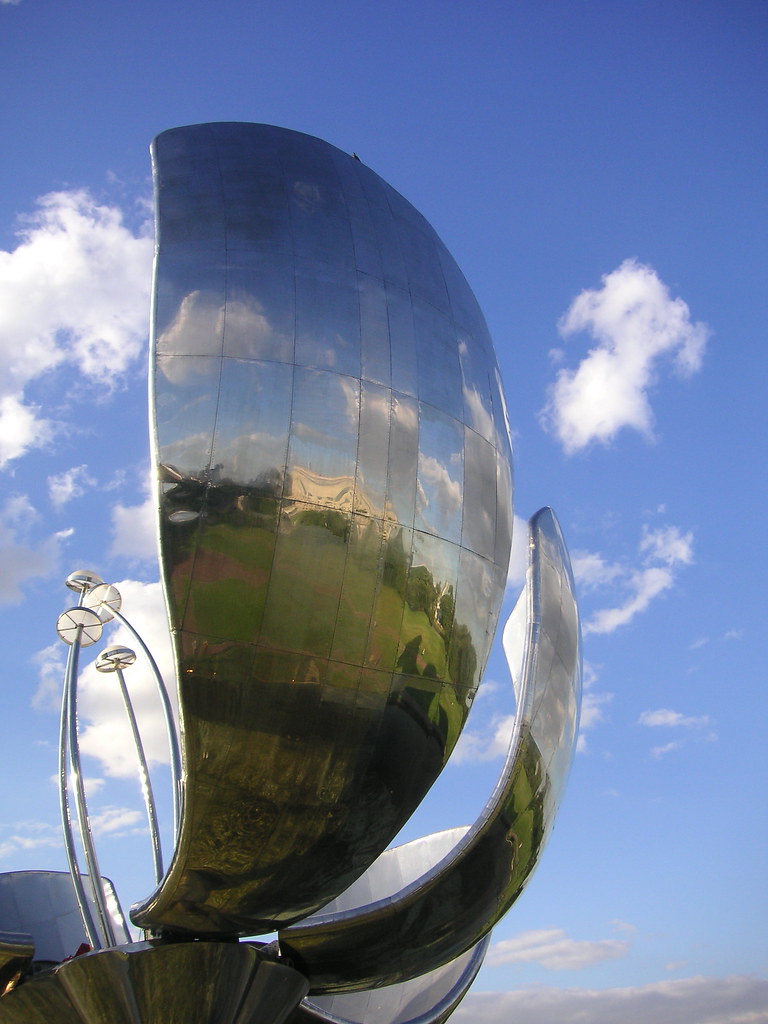
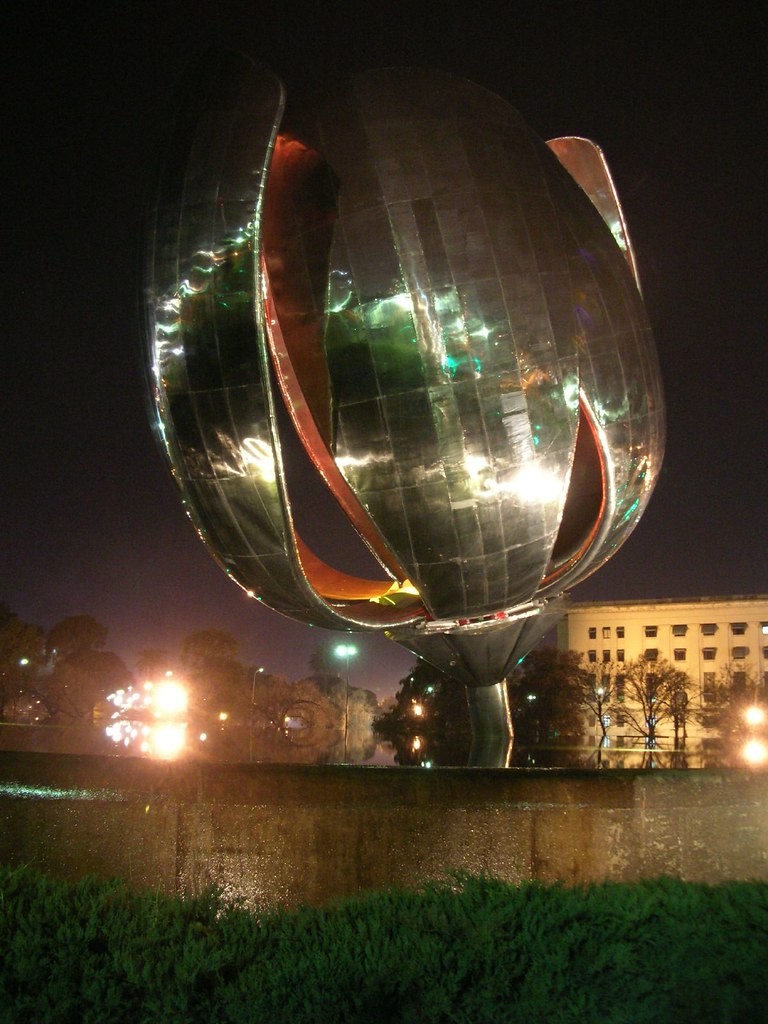
Its real name is Floris Genérica and it is something quite remarkable.  Standing in the middle of the United Nations Plaza (Plaza Naciones Unidas) you have to admit that the description is quite apt.  In the middle of a reflecting pool there it is – the big metal flower.

It was a gift to the city in 2002 from architect Eduardo Catalano.  The architect, who died earlier this year, was born in Buenos Aires and wanted a lasting display and thanks for his home city which reflected both its beauty and its modernity.  Opinions, as with any other piece of art, are divided but it is a potent symbol of both the natural world and the technological one.

The architect himself maintained that it was a synthesis of all the flowers and is both a hope that is reborn every day to open. An expensive hope, perhaps.  At US$6m (a gift from its creator) one might ask was a symbol worth that amount of money?  Most would probably agree it was: the pleasure it gives cannot be measured financially.

From afar it belies its dimensions which are colossal.  The flower has six petals and each of these is 13 meters in length and 7 meters at its widest.  The flower is made from stainless steel and is reinforced by an aluminum skeleton and concrete. 

It is only when you get closer your realise its full immensity. It towers about the pedestrians in the plaza at 23 meters in height and weights and enormous eighteen tons. It is no simple structure by any means – visitors who do not know its secret are in for a surprise twice a day.

This on its own would be remarkable yet there is a mechanism underlying the mostly static majesty of the flower.  Designed by the artist it was constructed by Lockheed Martin Aircraft Argentina.  That may give you a clue what happens.

It is simply enormous.

In the evening the petals close – taking around twenty minutes to do so and mimicking the process with which a real flower greets the sunset.   At night it is resplendent, bathed in red floodlights and array of smaller green lights dotted along the pathways.

If you have never visited Buenos Aires you may not be familiar with the fact that it is a city of dogs as well as people.  The Floris Genérica is popular with joggers for two reasons.  The plaza is a great shape in which you can measure your pace and the distance you jog.  It is also forbidden to dogs, which means your eyes can be elsewhere other than on the ground seeking to locate and then avoid the little presents the canine throng would otherwise leave behind.

On four days the petals stay open all night:  September 21, May 25, December 24 and December 31. The first is Argentina’s National Patriotic Day, the second celebrates the day on which Mario Bunge, Argentine philosopher and physicist was born in 1919.  The last two we think you can guess for yourself.