8 December 2024

The Monastery Built on a Volcanic Plug

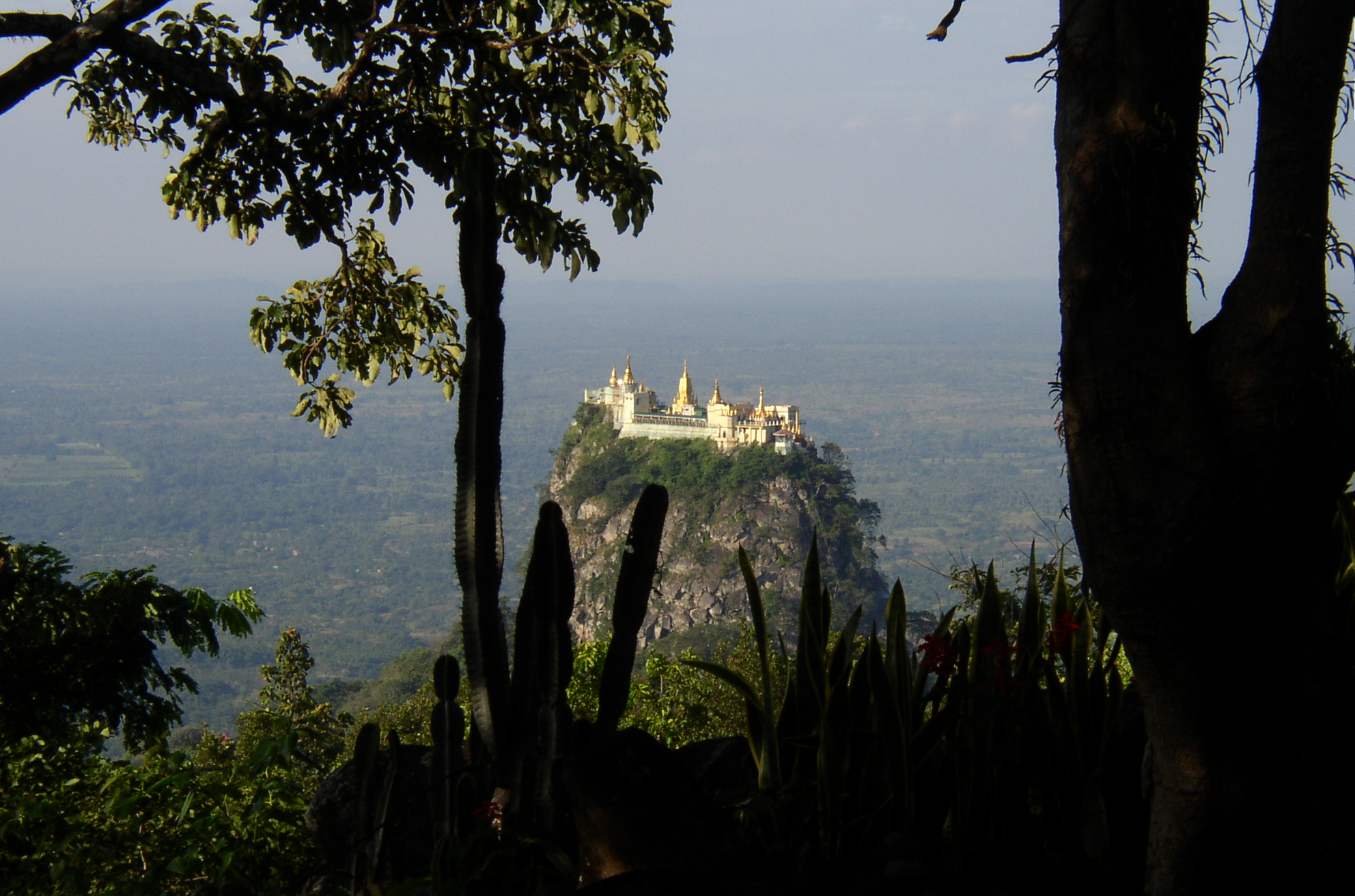
Yes, that’s right. A volcanic plug. Take a look at this amazing place. Taung Kalat, located in central Burma, thirty miles or so from the ancient city of Bagan towers above the earth like some sort of giant’s sand castle. Atop it there is a Buddhist monastery which rests upon the precipitous volcanic plug.

Yes, that’s right a volcanic plug. It sounds dangerous but at this stage in its life, Taung Kalat poses no threat. A volcanic plug (sometimes called a ‘neck’) is formed when magma, on its way up through a vent on an active volcano, hardens inside the vent. While the volcano is active this could well lead to the mother of all explosions and it would, you have to admit, be a shame if this beautiful monastery was to be catapulted in to the stratosphere. However, the volcano is thought (perhaps we should say hoped) to be extinct.

12 February 2024

The Maijishan Grottoes - Artistic Treasure of China’s Past

China has four major Buddhist cave complexes - by far the most visited being the Longmen caves. Less well known are the Maijishan Grottoes. Situated in Gansu Province in the northwest of China, this astonishing example of cave architecture hewn from rock consists of over 7,000 Buddhist sculptures not to mention almost 1000 square meters of murals.

31 May 2011

The Monastery built on A Volcanic Plug

Yes, that’s right. A volcanic plug. Take a look at this amazing place. Taung Kalat, located in central Burma, thirty miles or so from the ancient city of Bagan, towers above the earth like some sort of giant’s sand castle. Atop it there is a Buddhist monastery which rests upon the precipitous volcanic plug.

It sounds dangerous but at this stage in its life, Taung Kalat poses no threat. A volcanic plug (sometimes called a ‘neck’) is formed when magma, on its way up through a vent on an active volcano, hardens inside the vent. While the volcano is active this could well lead to the mother of all explosions and it would, you have to admit, be a shame if this beautiful monastery was to be catapulted in to the stratosphere. However, the volcano is thought (perhaps we should say hoped) to be extinct.

The monastery is still actively used in the practice of Buddhism. Although many locals divert from the religion in its strictest form, also worshipping the Nats, thirty seven spirits revered in conjunction with Buddha, the monks retain an important role in the community. The volcano is thought by the Burmese to be the home of the most important Nats and as such is often referred to as their country’s version of Mount Olympus.

At dawn there is little to compare to the serenity and beauty of Taung Kalat. It is unsurprising that the local people believe it to be the home of the Nats. Which semi-divine being wouldn’t want to make his or her home here?

To get to the top of Taung Kalat is arduous, but once there the views are breathtaking. There are an astounding seven hundred and seventy seven steps up to the top of the volcanic plug. One of the more renowned Buddhist hermits, U Khandi, who died in 1949, maintained these stairs for many years. A shame then, that the Burmese Government does so little to protect the site or the local people.

The monastery is often called Mount Popa but this is a misnomer. That is the name of the volcano. The volcano, thought to be extinct, dwarfs the monastery, the name of which translates to ‘pedestal hill’.  The local people call the volcano Taung Ma-gyi which means ‘mother hill’ to avoid confusion between themselves, but tourists tend to get it wrong.

The stupa of the monastery are remarkable pieces of work. From this vantage point it is best not to look down as the walls of the plug seem almost vertical from here and there is little protection in terms of hand rails. In other words, don’t get dizzy and slip from this point.

The Macaque monkeys have made their home on Taung Kalat. However, they are wild animals and should be approached with caution. They are quite likely to steal anything you place on the ground for more than a few seconds so tourists are always advised to carry their belongings at all time.

If you can manage the steps up to the top of the plug then you will enjoy views in all directions around the monastery. There is the city of Bagan, ancient and inscrutable from one point. From another the volcano rises like a Burmese Mount Fuji. The caldera (its cauldron like shape, created when land collapsed) of the volcano is huge so that the mountain takes different shapes from the various directions.

As well as being the bringer of death and destruction the volcano has ensured the area is rich in both flora and fauna, including the ubiquitous Macaques. Popa is thought to come from the Sanskrit language and means ‘flower’. While the areas around the volcano are fairly arid, the soil here is extremely fertile, being made up of so much volcanic ash. In contrast to much of the region, Popa has around two hundred streams and rivers.

You are guaranteed a friendly welcome from the local vendors who rely on tourism for their living. It is unfortunate, however, that the military junta which runs the country neglects its citizens. The sites are not adequately protected from either the elements or the tourists and the army may even have used forced labor in the area. However, when stable government is properly returned to the country, this is bound to be high on the list for many to see.

5 November 2010

The Ajanta Caves – Ancient Temples Carved from Rock

Two thousand two hundred years ago work began on an extensive series of cave monuments in Maharashtra, India.  Over a period of hundreds of years, thirty one monuments were hewn piece by piece from the rock face.  Then, some speculate around the year 1000AD, they fell in to disuse.  Dense jungle grew around, hiding the caves away from human eyes.

14 August 2010

The Amazing Monasteries of Bhutan

The Kingdom of Bhutan is sometimes overlooked, locked between Tibet and India, but the Land of the Dragon as the Bhutanese call it is home to some of the most exquisite Buddhist monasteries in the world.  Here, we take a fleeting visit to some of the over forty monasteries in Bhutan – quite a number considering the population of the entire country is only around 700,000.

Taktsang Dzong
Image credit Flickr User taxidesign
The Taktsang Monastery (also known as a Dzong) is high up in the Paro valley area of the country and work started on this amazing structure in 1692, the same year as the first Salem Witch Trial.  It is said that the famous guru Padmasambhava pursued his meditations here for three months.  It is quite possibly the most famous cultural symbol of Bhutan.  Local legend has it that the guru flew here from Tibet on the back of a tigress which gives the place its other name – the Tiger’s Nest.  The cliff upon which it hangs is 3,000 feet above the valley below.  One of the access routes is known as the Hundred Thousand Fairies – and you can see why from the picture below.  Simply put, the place is magical.


Punakha Dzong

The old capital of the country (till 1955) is Punakha and it is home to perhaps the most imposing Dzong in the country.  When built they also served as protective fortresses so they are usually set in the most commanding position geographically – such as at Taksang or here at the confluence of the rivers.  It was finished in 1638 – and as such is the second oldest in the country.  Each year there is a festival at the Dzong called Demoche and it recalls the 1639 invasion of the country by the Tibetans who were successfully repulsed.

The monastery is positioned at the confluence of two rivers, which have the most marvellous names.  The first is Pho Chhu and the second is Mo Chhu.  They translate simply as father and mother.


Tango Monastery
Travel less than ten miles north of the capital of Thimphu and you will discover the Tango Monastery.  Founded in the thirteenth century the building itself dates from 1688 (as you may have surmised the late seventeenth century was a period of much monastery building in Bhutan).   Like many Bhutanese monasteries, Tango was built over a cave where meditation and miracles were said to take place.  The monastery has no less than twelve corners and, it is said, was built in only two months – including the six temples within.

Tongsa – The Door to Heaven
The center of Bhutan and the west of the country are separated by the Black Mountains.  Until a few decades ago there were only foot trails in to this part of the country and you would have to forget about motorised transportation and take a mule instead.  The view from the Tongsa monastery is so beautiful it is little wonder it is referred to as the door to heaven.

Tongsa monastery is the largest in the country and it was built in 1648.  It was constructed at this point because it is at the perfect strategic position to survey the landscape for many kilometers around.  It was also built so that any visitors to the region by dint of sheer geography would have to visit the monastery – and so it controlled the traffic from the east to the west of the country.

Cheri Monastery
Cheri Monastery, also known as Chagri was created in 1620 by the founder of the Butanes state, Zhabdrung Ngawang Namgyal.  It is close to the capital city, but once you travel those ten miles you will have to spend the next hour walking up the hill to reach the monastery.   Namgyal was only twenty seven when he founded the monastery and he retreated there for three years after its construction as well as many other times in his life.


Rinpung Dzong, Paro
Paro is home to the only international airport in Bhutan so the chances are that the Rinpung Dzong might be the first you lay your eyes on if you were to visit the country.  It was built in 1647 and was intended to serve as a defense against the Tibetans (who seemed to have something of a habit of invading this country).  The name Rinpung means a on a heap of jewels and you can perhaps see why it was given this name.

The monastery has had a troubled history – t survived an earthquake in the 1800s only to be severely damaged by fire in 1907 – which is why perhaps it looks fairly new.  You may recognise the site from the movie Little Buddha much of which was filmed in the dzong.  There are an amazing fourteen shrines and chapels in this five storey structure.

Each year an enormous banner which shows the eight manifestations of the Guru Rinpoche is shown to the pilgrims.  The festival (which is known as a tsechu) lasts for fifteen days and on the dawn of the last day the Tongdrol banner is unfolded.  A few hours later it is removed until the next year.

Lhuentse Dzong
This Dzong was the home of the royal family of Bhutan for many generations but has been a monastery since 1654.  There are five temples inside the Dzong, all but two of them in the tower at its center.   It was built here originally because the ridge upon which is stands is said to resemble the trunk of an elephant.

Over 100 monks reside here – and they have a sense of humor too.

28 March 2010

The Biggest Book in the World


King Mindon of Burma wanted to leave something to posterity.  As a book lover he thought that literature was one of the most valuable elements of an enlightened society so he planned to leave a book behind him.  Not any old book though – this would be the largest book in the world.

The King wanted the book to last for five thousand years so paper would not do.  In 1860 he started the construction in Mandalay (then the capital of Burma).  At the base of the Mandalay Hill still stands the largest book in the world.  Its dimensions are staggering: the book has seven hundred and thirty leaves and one thousand six hundred and forty pages.  Each one is made from local marble and has around one hundred lines of writing upon it.

It doesn’t end there, though – each of the pages is three and a half feet wide and five feet tall.  In order to stand freely these pages are five inches thick.  Each of these stone tablets has its own roof and they are all arranged around a central, golden pagoda – known as the Kuthodaw Pagoda.  The book itself does not tell the story of Mindon’s life – many persons of royal lineage would no doubt be tempted to give a version of their own history dressed, no doubt, in flowery hyperbole. Each page is contained within its own glistening white pagoda to protect it from the elements.

Together the rows of pagodas form the biggest book in the world - and this is how Kuthodaw is now known. The book contains the Pail Canon, which is a collection of scriptures in the Theravada tradition of Buddhism.  First written down over two thousand years ago, Mindon felt that these scriptures would be a fitting testament to his life.  We know this because the seven hundred and thirtieth leaf of the book records the actions of the king for posterity.


To get an idea of the scale of the whole incredible project, there is a model of the whole book system in the museum area of the site.  You can see the central golen pagoda clearly here.

The construction itself is a remarkable story.  The marble was quarried from thirty miles away and taken by river to Mandalay.  When the work began in 1860 the stones were worked in an enormous shed and hundreds of senior monks were involved in the editing of the sacred scriptures.  Each stone has up to one hundred lines of inscription upon it – and these were originally filled with gold ink.

Buddhist monks continue to be the custodians of the site.

It took eight years to complete the book and it was opened to the public in 1868.  Originally, each of the tablets had a precious gem in a casket on its top.  When the British invaded the north of Burma in the 1880s the gems were stolen.  There was a restoration in the 1890s but it took till the latter part of the twentieth century for the book to be restored to its old glory.

It attracts tourists and devout Buddhists from all over the world.  Perhaps it is at its most beautiful at dawn.  Still, King Mindon's plan came to fruition and although it remains to be seen whether it will persevere for five millennia, it is as likely now as it ever has been.