31 January 2011

The Oak Chapel of Allouville-Bellefosse

It is like something out a fairy tale or perhaps a Tim Burton film.  Yet the oak tree in the small French village of Allouville-Bellefosse is not a figment of the imagination or, indeed, an old film set.  A staircase spirals around its twisted trunk but neither is this an everyday tree house.  Instead of a dwelling place atop or amongst its branches the visitor will discover that the interior holds the secret of this ancient oak.

Within there are two small chapels, which are to this day used as places of worship by the local people.  How old the tree is exactly is the subject of some debate but it is without doubt the oldest known tree in France.  While it has persevered the centuries, others have come and gone but Chêne Chapelle (Oak Chapel) has remained.

It was growing when France became a truly centralized kingdom under Louis IX in the thirteenth century.  It survived the ravages of the Hundred Years War with the English.   The Black Death, the Reformation, the Revolution and the time of Napoleon all came and went as it spread its branches.

Local folklore places the time at which the acorn first took root as a thousand years ago. They maintain that William the Conqueror said prayers at its base before he went off to thrash the Anglo-Saxons near a small seaside town called Hastings. Yet tree experts put the real age of the tree at around 800, which puts its roots firmly in the thirteenth century.

As such it is still a wood-framed mirror to the history of modern France and of course each country has its disasters. Catastrophe occurred for the oak in the late 1600s.  It was nearing 500 years in age when one stormy night it was struck by lightning. A bolt with a temperature approaching 30,000 °C pierced the magnificent tree to its heart.

Yet instead of dying, something astonishing happened.  The fire within burned slowly through the center and hollowed the tree out. Perhaps it should then have simply slowly rotted away, but each year new leaves would form and the tree would produce acorns in abundance. In those religious times it was not long before the miraculous tree gained some pious attention.

The local Abbot Du Detroit and the village priest, Father Du Cerceau, determined that the lighting striking and hollowing the tree was an event that had happened with holy purpose. So they built a place of pilgrimage devoted to the Virgin Mary in the hollow.  In later years, the chapel above was added, as was the staircase.

The chapels are called Notre Dame de la Paix (Our Lady of Peace) and the Chambre de l'Ermite (Hermit's Room).  On August 15 of each year it is still a site of pilgrimage for local Christians.  However, the tree had at least one moment of peril after the original lightning strike.

The need to survive sometimes precipitates change. During the Revolution the tree became an emblem of the old system of governance and tyranny as well as the church that aided and abetted it.   Le Chêne chapelle was to experience its own terror.  A crowd descended upon the village, intent on burning the tree to the ground.

However, a local whose name is lost to history had an inspired thought – as sometimes people do when they have to think at a speed approaching light.  He renamed the oak the temple of reason and as such it became a symbol of the new ways of thinking. It was thus spared the lightning strike of political revolution.

Of course, a tree this old cannot go on forever and Chêne chapelle is showing its age.  Poles must shore up its weight where it once it bore its own, like a giant stretching. Wooden shingles have been used to cover areas of the tree which have lost their bark.  Yet as much care and diligence is given to the tree as can be, to ensure that it lives on as long as possible even though part of its trunk is already dead. Yet twice a year its loyal congregation gathers and mass is celebrated within the confines of this remarkable chapel of oak.

Kuriositas would like to thank Flickr photographers Philippe_28, Solangenp2004, Comment vous dire? and FRBC for allowing us to reproduce their marvellous photographs here.  Please visit their photostreams!

30 January 2011

Fellowship Towers - A Home for Heroes

Even heroes get old. So, what might happen to the Lord Of The Rings characters age and need a little more help with everyday things than they once did?  Well, there is always Fellowship Towers which will take them in and care for them – in return for a ring or two no doubt.

Unfortunately there was no additional information about where this was on Flickr, so if you have an aging hobbit or elf on your hands at the moment, please do not email me!

Salvator's Philosophy

I thought I would take an opportunity to share with you one of my favorite pieces of art. It is a self portrait by the rebel without a pause, Salvator Rosa, who died in 1673. It is entitled Philosophy and was painted in 1640. While you may scratch your heads today as to what the Latin inscription means, scholars of yesteryear had no such problem and found this picture immensely amusing.

It means:

Keep silent unless what you are going to say is more important than silence.

Eyes


The eye sees a thing more clearly in dreams than the imagination awake.
Leonardo da Vinci

The eyes are the mirror of the soul
Yiddish proverb

Who are you going to believe, me or your own eyes?
Groucho Marx

This is a great collage of pictures by Mortimer Brewster.  Throw in an REM soundtrack and you have an interesting four minutes. 

Paula Bunyon - The Musical


You may be familiar with the story of Paul Bunyon, but did you realise that the story is just a myth and that the real Paul was actually Paula? No, truth be told, neither did we, but here is Lisa Dosson's imaginative retelling of the story from the perspective of Paula rather than Paul.

To cap it all, it’s a musical! This is a funny and whimsical piece of animation – and the song is sure to get your foot tapping. Showing more than just her animation skills, Lisa also wrote the lyrics and sang the number as well.

29 January 2011

The Ice Book


Technology allows performance art to do things today that were only dreams a few years ago. The Ice Book tells the story of a princess who entices a boy into the woods so that she can warm her heart of ice.

The performance merges the moving picture, puppetry, and film to take a pop up book and bring it to life in an extraordinary way. I really like the way in which lit and unlit scenes are shown so we can see the transformation ourselves.

This is the work of husband and wife team Kristin and Davy McGuire, who create genre-busting productions for stage, screen and exhibition spaces that blend elements of film, animation, theatre, puppetry, installation art and good old-fashioned illusions in to something quite new and different.

Egypt: A Nation Forced Offline


The political situation in Egypt, where people are protesting against the virtual dictatorship of Hosni Mubarak, has meant that it has become the first country in the world to block all internet and cellular access.

This sorry state of affairs has come about for a variety of reasons. If you need your head refreshed as the build up to this enforced isolation from the rest of the world take a look at this timely animation by Michael Marantz. It takes the Tunisian explosion of demonstrations as its starting point and brings you up to date.

Let’s hope the people of Egypt can break themselves free from the shackles of truly repressive government in the very near future.

28 January 2011

Lightheaded


If you want to be something other – or more – than what you are, then sometimes you have to make sacrifices.

This is a very cool animated short film by Mike Dacko. As such it is his first independent film. General advances in 3D allowed him to fully realize a concept he had come up with a long time before the technology existed to make it real.

He managed to create all of the visuals on a Dell laptop. Wow!

What is a Social Network?


What i
This may seem, in this day and age, like an obvious question but sometimes the answer is harder than it seems. 

What is a social network is one of those questions that you think has a quick and easy answer until you try to articulate it.

So, using Facebook as an example here is a pretty good definition of a social network, nicely put together by Robin Al.  So, next time someone asks you, you have the answer at your fingertips!

Forever Young


This is lovely.  An old woman reminisces about her youth, the love, the music, the energy – and is transported back to her heyday by the magic of memory.   There is little plot here – it is more of an animation of insight than of story – but the back plot is rich and it is easy to imagine a whole lifetime in just a few minutes.

This is a student film, made by Solveigh Jäger at the Media University of Stuttgart – so as such you have to forgive the rough edges as this was made on a miniscule budget.  Yet it is obvious that a great deal of care – no, love – has gone in to this project.  Thanks, Solveigh, for suggesting that we feature this – you should be exceptionally proud of your work!

This charming animated short will make you feel all warm and fuzzy, so if you are feeling a little low, give it a go!

23 January 2011

Desert Bizarre

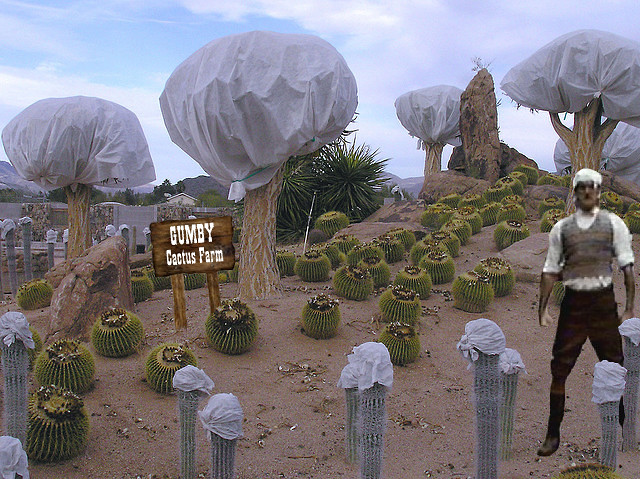
This is a landscaping and nursery business in Cave Creek, Arizona. Flickr user Cobalt 123 was driving by on the highway and spotted an amazing nursery devoted to desert landscaping and saw this rather bizarre sight.

He has no idea why the trees and cactus are bonneted, but the effect I am sure you will agree is quite surreal.My own second best guess is that they are to protect the cacti and other plants from the atmosphere, which I find a little unlikely if they already grow there.  The better guess is that they are there to protect the tops of the animals from the pecking beaks of local birds, particularly if they are bearing fruit.

Most likely neither is correct, but if you know the answer, please let us know!

Postscript:  Although I am more inclined to believe the first commenter below, Kuriositas Axton Nichols - (ltsalts on Tumblr) has given us food for thought.

No, surely not.  Please, tell me it's not true.

A Turn of the Gear


This lovely animation takes the old adage that life is like a merry-go-round and takes it literally.  As an extended visual metaphor for a young girl growing up and achieving her independence it really is very well and sensitively done. Un Tour de Manege (A Turn of the Gear) shows the journey from youth to adulthood with sensitivity and frankness.

I particularly like the use of pastel colors and the symbolism (did you see the wolves when she meets a boy?).  Of course, in the end, she returns safely to the arms of her mother – but look at the knowing glance that she gives to the ‘camera’!

Babies From The Future


One day you are preparing your baby’s bottle and then he turns round and tells you to listen very carefully because he needs to make a phone call. What would you do? That question is posed in this trailer for the latest sci-fi thriller, Babies From The Future.

Well, OK, it may not be a thriller: it may well have its tongue well and truly in its cheek. Maybe. Yet you could easily imagine Hollywood coming up with this sort of idea – a kind of Look Who’s Talking with guns and rockets or Red Dawn with diapers. Yes, in a glorious nod to that era of Hollywood movies, there is even a Red Army baby thrown in for good measure.

With the byline Is Your Baby From The Future? this concept could easily take hundreds of millions at the box office.  Cameron must be kicking himself that he spent all that money on developing software to portray seven foot blue aliens when the ultimately marketable movie was staring him in the face, milk bottle and all. Who needs avatars when you have babatars?

This is bliss to watch, so a big thanks goes to its writer and director T C C Taylor – whoever the Academy Award for Trailer for Film Yet to be Made goes to this year, he was robbed. The baby’s speech is flawless – it really looks quite peculiar – and the FX are pretty awesome too (particularly at the climax). Hats off also to the adult actors, Josef Ber and Beth Champion, for doing all of this with a completely straight face.

Now, I really, really want to see what happens next. Babyocalyspe? You can find TCC Taylor's site here and the official movie site here.

22 January 2011

Blobitecture – The Rise of Organic Architecture

Experience Music Project, Seattle, Image Darwin Bell
They might perhaps be at risk of coming across like characters in a scene from a certain Monty Python film, but some people still insist on asking the question what have computers ever done for us?  One mooted answer could certainly be blobitecture (or, blobism, blobismus or blob architecture) for this architectural term could not have become reality without them.

Selfridges, Birmingham UK - Image Mags_cat
Selfridges, Birmingham UK - Image Wojtek Gurak
Yet what is blobitecture?  It is a term for an architectural school in which organic shapes are the aim, bulging, cellular, amoeba-like buildings its expression.  Although the term did not appear in print until 2002, blob architecture had been used as an expression in architectural circles since the middle of the previous decade.  Notably it was the New York Times which first brought it to greater attention, as part of William Safire’s On Language column.

Guggenheim Bilbao, Image dyangchi
Guggenheim Bilbao, Image cuellar
Safire did not use the term politely.  However, it was a word that, thanks to his denigration of the form, took off and came to define it.  Yet definitions change and when Safire launched it on to the wider world it the word (and the form as people saw it) would evolve.

The Sage, Gateshead UK - Image alephnaught
Millennium Bridge and The Sage, Gateshead UK - Image Simon and Vicki
The Sage, Gateshead YK - Image hap
Blobitecture is distinct from other architectural forms as it wholly created from computer-aided design (CAD). Architects employ CAD to control buildings' outlines to practically any form. To enable them to do this, the software automatically computes mathematical equations that implant structural accuracy and dependability into the design. Before CAD's maturity as a tool, architects remained in thrall to a conventional geographical character as they were certain that these shapes had structural stability. Now, thanks to CAD software, the shape of a building has unlimited potential.

Experience Music Project, Seattle - Image Darwin Bell
Experience Music Project, Seattle - Image J-Bird in K-Town
Experience Music Project, Seattle - Image Selva
We have architect Greg Lynn to thank for the original term – he invented it in 1995 to give definition to his experiments in digital design.  He used metaball software, the technique for which had been invented by Jim Blinn (a NASA computer scientist) in the first years of the 1980s. This blobby modelling (real term) enabled the creation of organic-looking n-dimensional objects, where n is the number of dimensions (usually 2 or 3) being measured.

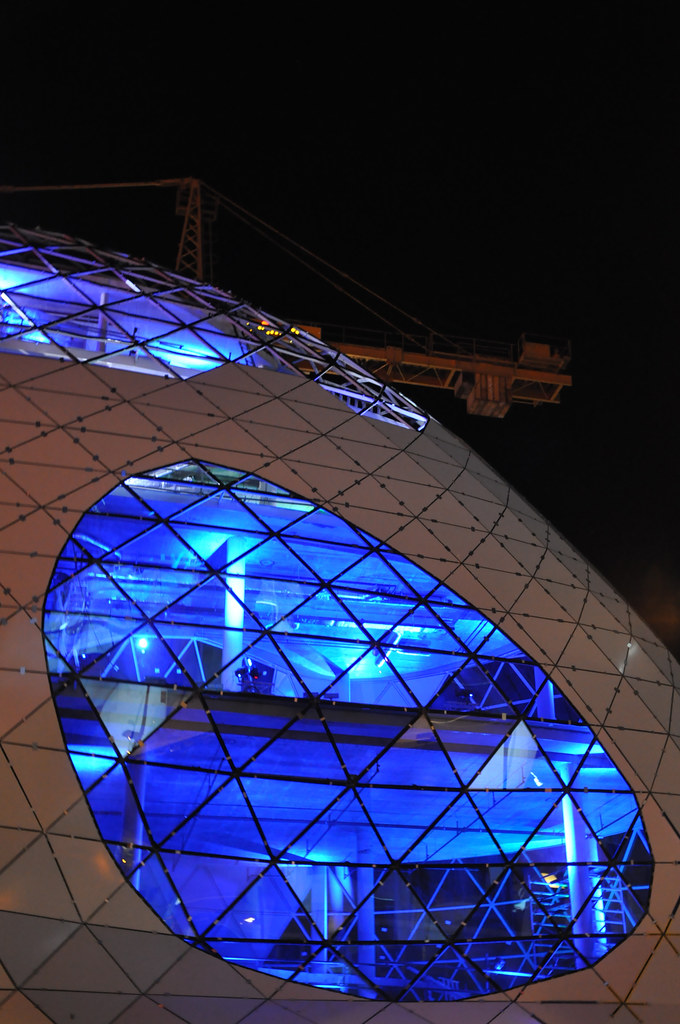
The Blob, Eindhoven Netherlands - Image Andrew B47
The Blob, Eindhoven Netherlands - Image Truss, Bob + Jan too
Lynn used the term as a substitute for biomorphic form, deriving it from a kind of acronym from a technical description of a computer-formed shape - a binary large object.  He envisioned blob architects discovering a new form of splendor, sophistication and elegance in the voluptuous, cadenced and undulating shape of differential calculus.

Zlote Tarasy, Warsaw Poland - Image Zlote Tarasy
Zlote Tarasy, Warsaw Poland - Image Wasilka
Zlote Tarasy, Warsaw Poland - Image Access.Denied
Put simply, without computer-aided design, blobitecture would be impossible – as would the new and unusual forms that architects and furniture designers were experimenting with shortly after Lynn.  The manipulations of the algorithms needed to derive the forms are impossible to do on paper.

City Hall, London - Image Kol Tregaskes
City Hall, London - Image Dmitry B
City Hall, London - Image K_Gradinger
Yet if you view blob architecture from the idea of form rather than that of technology there are certainly precedents – and buildings that would fill your definition.  Projects by Buckminster Fulller, famous for geodesic domes, have the style and structure which would later be associated with blob architecture.  The English architectural group Archigram was interested in shapes that could be created from plastic or even inflated.  Their ideas would be likely looked upon as blob by at least the layman.

Graz Art Musem, Graz Austria - Image rpeschetz
Graz Arts Museum, Graz Austria - Image Watz
Graz Arts Museum, Graz Austria - Image Identity Chris Is
A member of Archigram, Peter Cook, would go on to be at the forefront of blob architecture with the Graz Art Museum (Austria) in 2003.  This building and others has taken the definition of blob architecture from its original, if narrow, interpretation – that it was to be born solely from computer modeling techniques. 

Aqua Tower, Chicago - Image ChicagoGeek
Aqua Tower, Chicago - Image John Picken
Aqua Tower, Chigo - Image John Picken
With any definition, one must go with the zeitgeist. Meanings change and now blobitecture is associated much more widely than Lynn’s original idea.  In fact any odd shaped or looking building is often referred to as an example of the form, which while not being correct, is right in terms of the popular definition of the word.

Experience Music Project, Seattle - Image Selva
Guggenheim Bilbao - Image Le French Monster
Frank Gerhy took to Blob architecture in 1997 with his design for the Guggenheim Museum Bilbao and followed it up with EMP|SFM (known as the Experience Music Project for short) in 2000.  Yet although these would to the untrained eye look the epitome of blob architecture, following its narrowest of definitions, they are not.  The reason?  They were designed using physical models rather than computer manipulations.

Dancing House, Prague - Image gdelargy
Gare de Seine, Paris - Image Alexandre Vialle
This is despite the fact that advanced computer-aided design software was used in their design. CATIA was particularly instrumental in the design of both buildings. This stands for Computer Aided Three-dimensional Interactive Application and is a multi-platform CAD/CAM/CAE commercial software suite developed by the French company Dassault Systemes.  It is marketed worldwide by IBM.

Philological Library, Berlin - Image maha-online
Philological Library, Berlin - Image Credit Jonas_K
Technically the first building designed through pure blob architectural techniques was the Water Pavilion, a temporary structure in Holland which stood from 1993 – 1997.  It was built by Lars Spuybroek (NOX) and Kas Oosterhuis and was of a fully computer based nature. Its interior was fully electronically interactive – light and sound could be changed by visitors.

Allianz Arena, Munich - Image Trodel
Allianz Arena. Munich - Image dloop
Another building that is considered blob architecture are the Allianz Arena by Herzog and de Meuron. Norman Foster has also involved himself with blob architecture, with his design for the Philological Library in Berlin as well as the Sage Gateshead which both opened in 2004.

Graz Arts Museum, Graz Austria - Image Weiko
As architects break further free from traditional geometrical shapes, blobitecture is expected to become a more familiar aspect of global cityscapes. CAD is able to produce unlimited forms of blob architecture and many motivated architects are taking advantage of blobism’s seemingly unlimited boundaries to thrust architecture to its farthest limits.